What was produced
Big idea
Every Tuesday is now a Trailer to the Playbook.
Rename the relationship between the two surfaces. The LinkedIn post is the Trailer: the argument, free, public, complete enough to nod at. The Substack article is the Playbook: the named case, the fair objection, and the three actions a person can take on a Monday. The audience was not subscribing because they could not see what they would be subscribing to. Once the depth differential has a name, the click stops being a leap of faith and becomes the obvious next step.
Key message
"The Tuesday post is the Trailer. The Playbook is on Substack."
Every concept in this system must survive a 15-second radio read, roughly 40 voiced words. Not because the ad will air, but because 15 seconds is a brutal forcing function for message clarity. If the proposition cannot survive a constrained read-aloud, it is not tight enough to ship. This is the campaign's message in script form:
[voice: dry, Australian, unhurried, a half-smile]
"Every Tuesday on LinkedIn you get the argument. Free, complete, worth a nod. That's the Trailer."
"The Playbook is on Substack: the named case, the fair objection, the three moves to make this week. Four minutes, every Tuesday."
"The Signal."
[Drafted retrospectively for this case study. The discipline now applies to every concept.]
Marketing plan
Four workstreams, one proposition. Each workstream ships as finished assets, a selection of which are shown below.
- 18 historical LinkedIn posts analysed before a dollar moved
- Prior boosted post autopsied: wrong objective, $175 CPM against a $45 benchmark
- The important fact found: 14.9% of readers who clicked through subscribed
- CTA stamp with an application kit
- 12-pattern CTA library: closing lines, mid-post CTAs, day-2 comments, P.S. patterns
- Weekly LinkedIn tiles with in-situ feed previews
- Tuesday post, tile, and Substack Playbook opener, every week
- Post shape and CTA variant rotate across four weeks
- Eight of 17 assets fast-lane once the week 1 pattern locks
- $1,000 locked: $500 LinkedIn, $500 capped Reddit experiment
- Pre-registered A/B framework, CTA by post length
- Conditions written down before launch, not improvised after
Key assets
Real assets from the campaign, exactly as they shipped. Seventeen planned; the week 1 launch package alone was eight ship-ready files. The three below show the system from destination to Trailer.
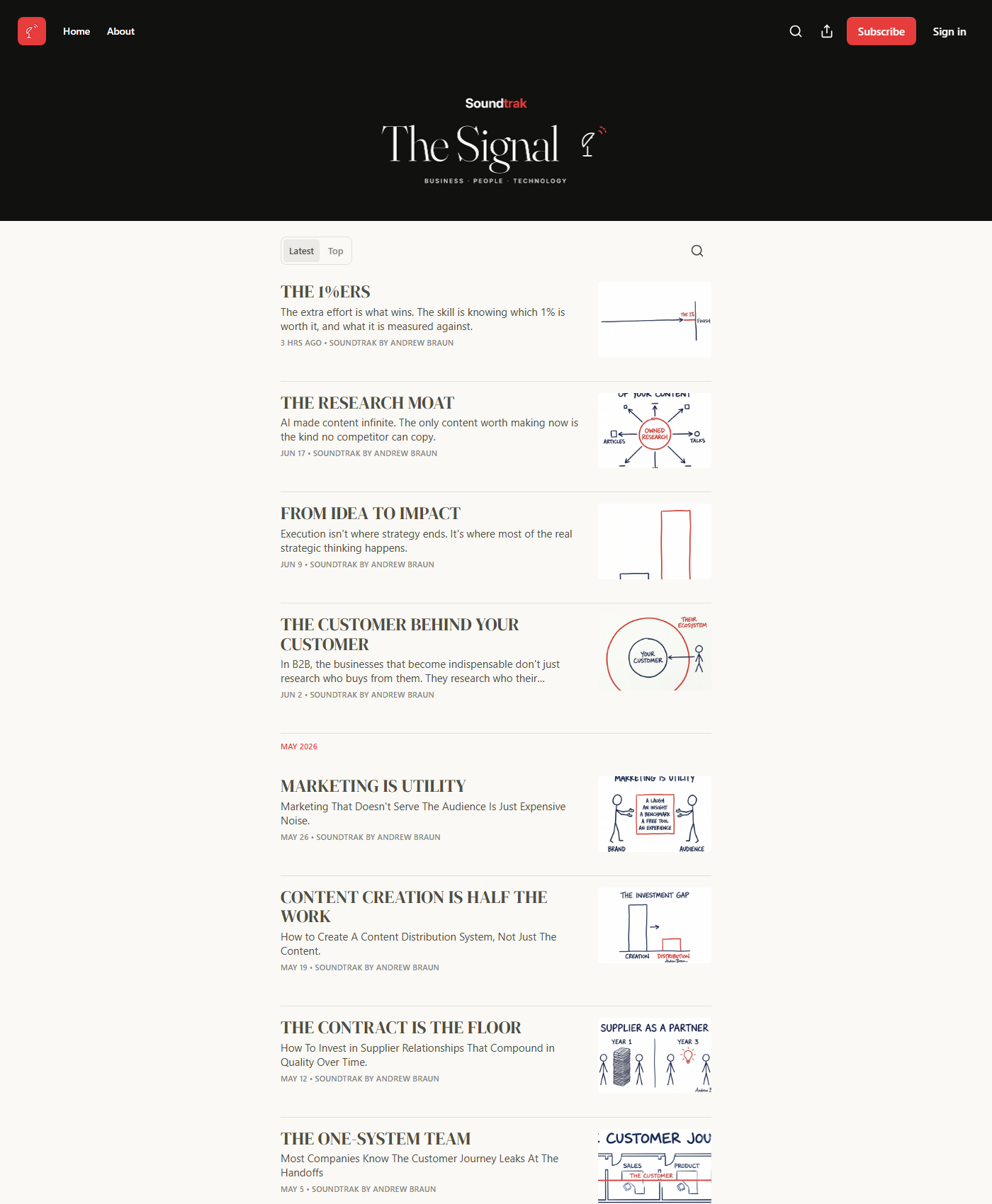
The destination, live. The Signal on Substack (ab64.substack.com): masthead, subscribe surface, and the archive of published issues every campaign asset points at. The week 1 article and hero shipped here as part of an eight-file launch package.
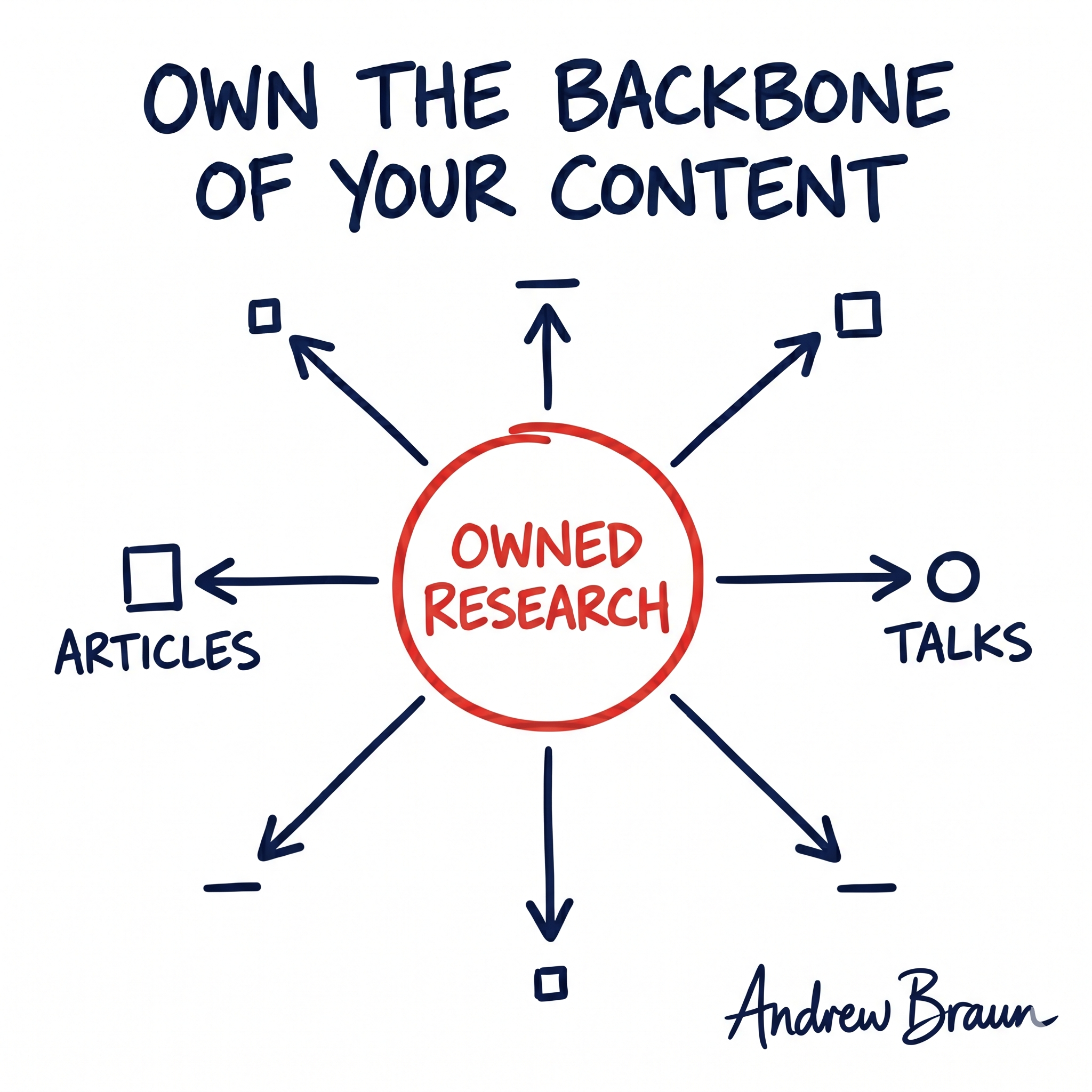
The hand-sketched illustration. A Substack hero produced by the system in the newsletter's own napkin-sketch style: own the backbone of your content, with owned research as the hub feeding every article, talk, and post.
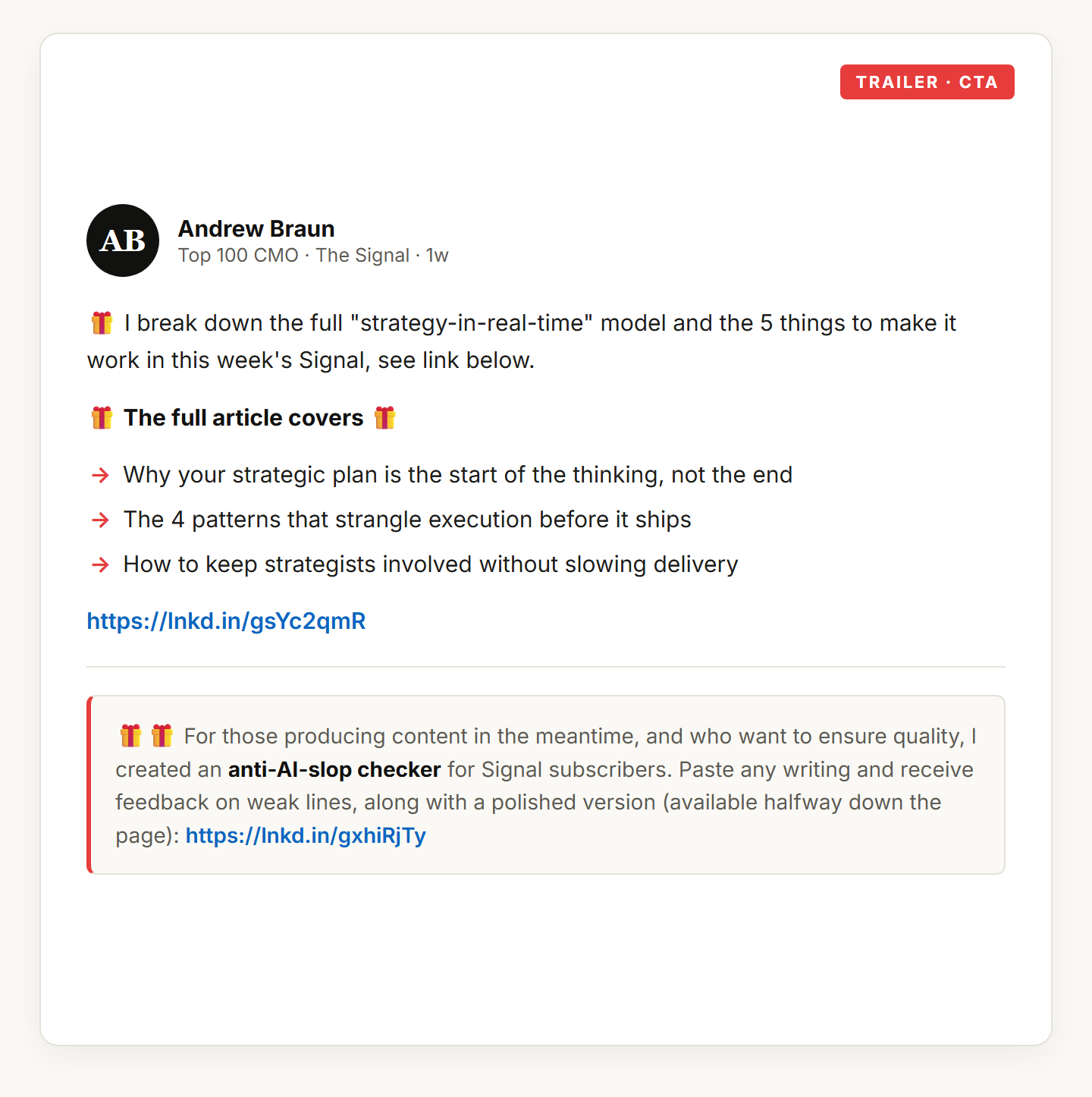
The Trailer's CTA. Every LinkedIn Trailer closes with a conversion CTA drawn from the 12-pattern library: the Playbook tease with the link, the "what the full article covers" bullets, and a free anti-AI-slop checker offered to subscribers.