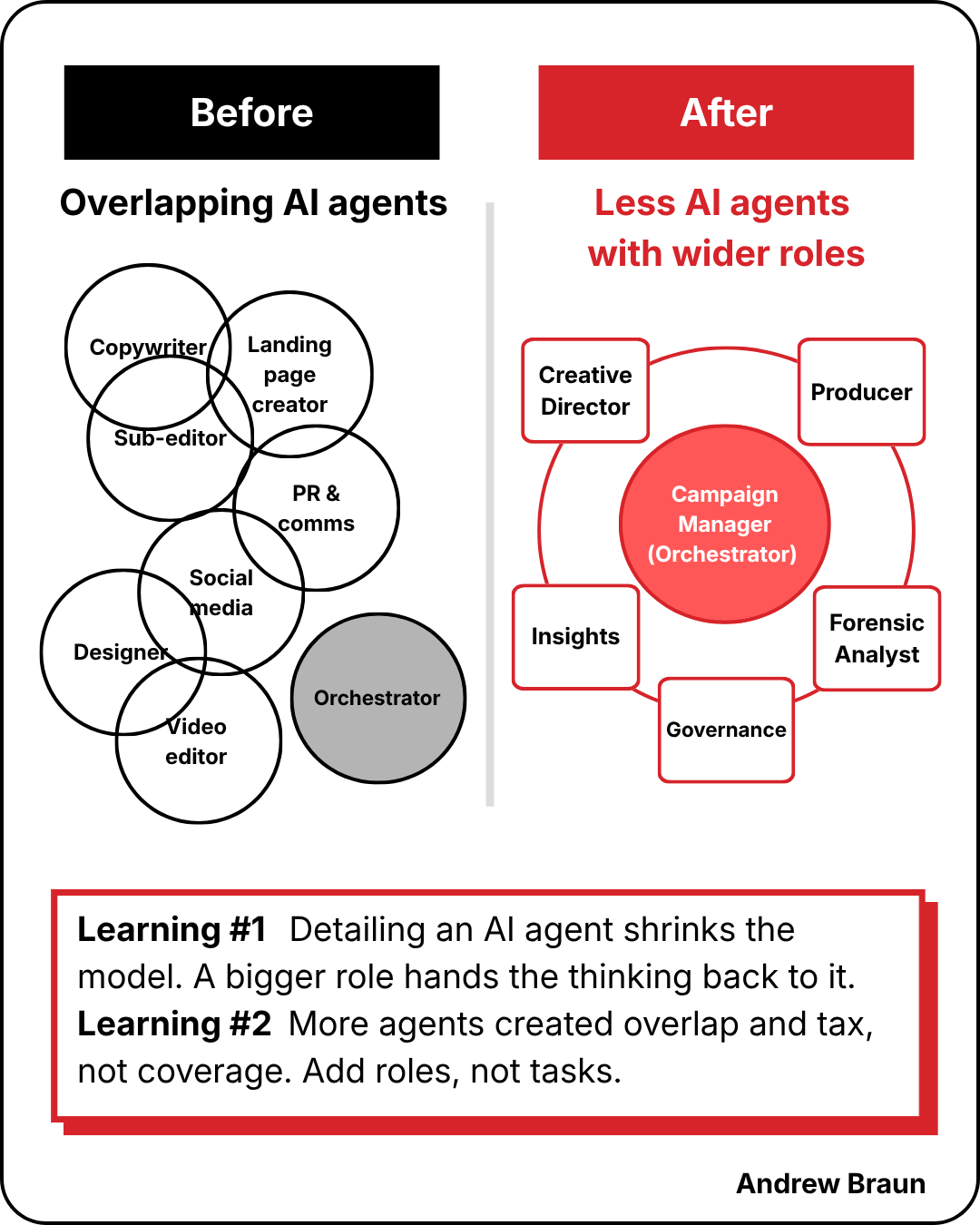
I built over a dozen AI agents to run Soundtrak's marketing and sales AI Studio, one for every output, mimicking a human marketing team. Then I cut half of them, folded work into a single agent role, and the output got better, not worse. Here is where I started, where I ended, and what it taught me.
The first version of the AI Studio had over a dozen agents in it, I had plans to build more.
Where I started
I gave every marketing task its own AI specialist. A copywriting agent. A sub-editing agent. A design agent. A SEO-ad agent sitting right next to the design agent. An email agent, a social agent, and more behind them. Over a dozen in all, with plans to build more, each one pointed at a single narrow craft and told, in careful detail, exactly how to do its one job.
The logic came straight from how you staff a human team. You do not ask your copywriter to art-direct the banner, so initially I did not ask one agent to do two jobs. If a real agency separates the copywriter from the designer from the media buyer, then surely a good AI marketing system should have one of each, mapped one for one. More specialists, more coverage. I knew better than to trust a single black box with the whole campaign, so I split the work as finely as I could and called it rigour.
But the rigour created overlap, and overlap does not compound, it becomes a tax.
Here is what I learnt. A social post needs an insight, creative direction, words, a picture, and a layout that hold together, made as one thing. Split across a creative director agent, copywriting agent, a design agent, that one post now crossed multiple borders. Every border was a handoff where the intent thinned out, where the picture stopped matching the copy, where the 'human-in-the-loop' had to reconcile three half-right drafts into one, creating more work rather than less. The problem was the copy agent and the design agent both thought they owned the headline. The creative director and the design agent both thought they owned the visuals. I had not divided the labour so much as multiplied the handoffs. I had built an org chart, not an AI studio.
And this happened not just for social posts, but for websites, for email marketing campaigns, for sales deck development. The rigour was creating more work for the human.
Where I ended
The team that runs GTM campaigns now is seven agents, and their edges rarely touch.
A Campaign Manager orchestrates the agents, ensures the right agent is acting at the right time, they also align the output of the AI agents to the business objectives. I built an Insights agent, whose role finds what the audience actually believes, what job they are trying to achieve, what will rock their boat. A Creative Director agent shapes the big creative idea, using the insights as one of its outputs. And the Producer makes the finished GTM assets. A Governance agent checks the output against the compliance guidelines, a Brand agent checks the output against the brand guidelines, and a Forensic Analyst agent interprets the data after the campaigns ships. Seven roles, each one a whole job, with no two reaching for the same task.
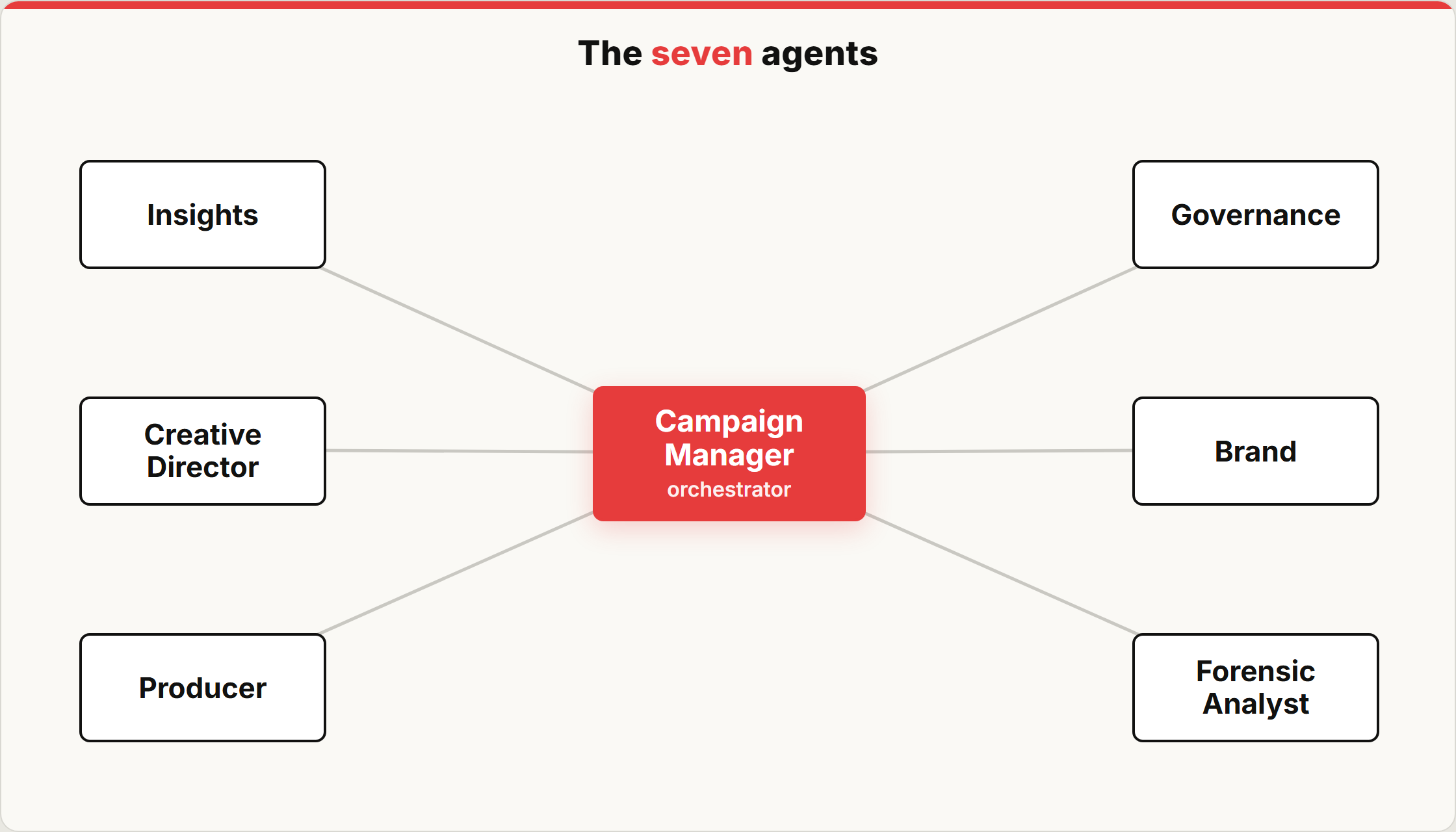
The seven agents. A Campaign Manager orchestrates six role-complete agents, where a dozen-plus single-craft specialists used to overlap. Each one owns a whole job.
The Producer agent is worth highlighting. By collapsing single-craft specialists (e.g. the copywriter, the designer, the SEO specialist, the email marketer) into a single Producer that owns the whole asset, the words, the picture, and the layout, a single agent was responsible for the final output, instead of it being passed between five narrow hands. The friction was not managed so much as deleted, because there was no longer a handover to argue over.
The other benefit is now I only need to maintain one Producer agent, not dozens of specialist marketing agents.
You may ask how? This is where best-practices, tools, evaluations and audits become essential. The reference files are now where the guidelines and frameworks live, which the Producer agent calls on when needed. These are the files which are maintained by me.
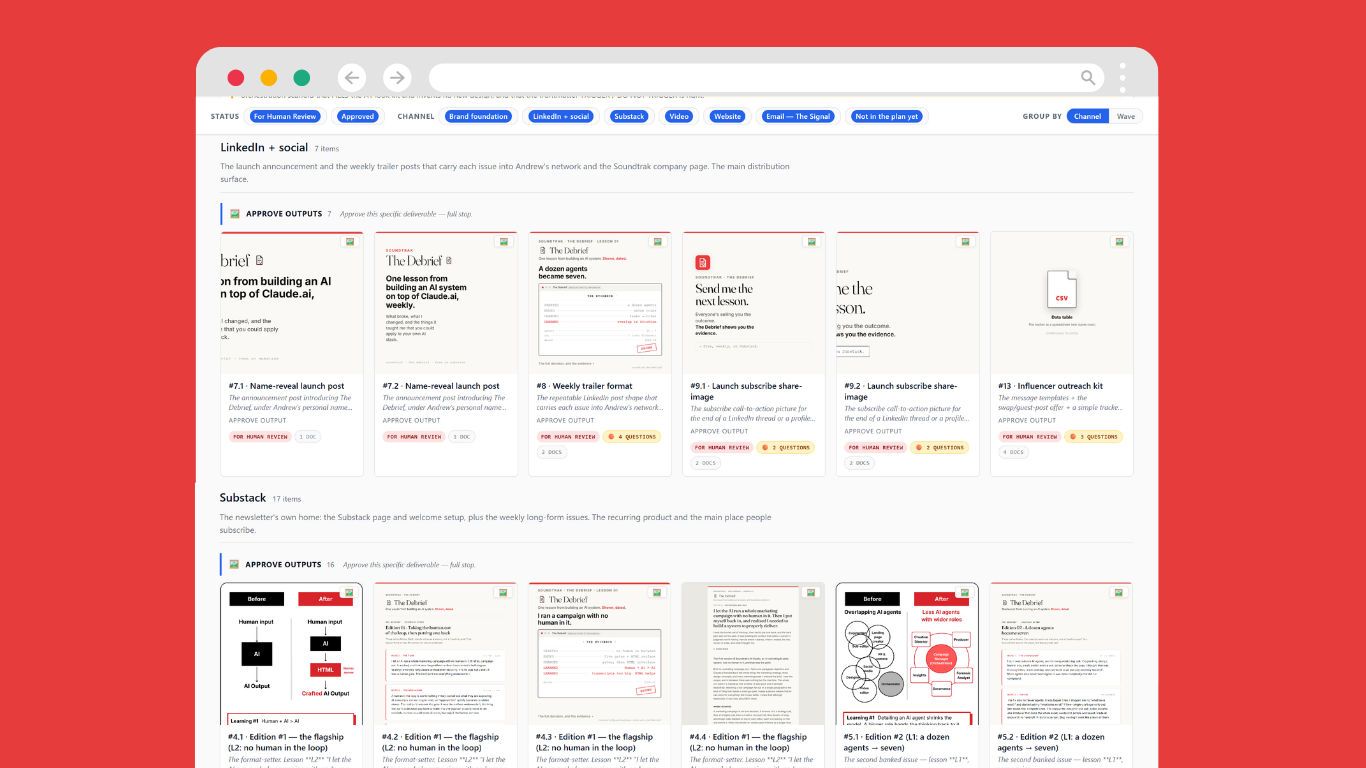
The AI Studio asset gallery. Social, web, paid, and video, all in one surface, each with its own review status. This is the finished output the single Producer role now owns, where single-craft agents used to hand off to each other. Not a mockup, the real screen.
What it taught me
Two things, and the second is the one I nearly missed.
First, the shape of the AI team. Tasks are endless and they overlap by nature, because real human work does not come pre-cut along task lines. A headline is copy and design and platform judgment at once. So dozens of task-agents collapsed into seven role-complete agents was the learning. When you find yourself adding another agent, stop and ask whether you really need it and whether you should consider expanding the coverage of an existing agent.
Second, the one that actually matters most.
When I gave each of the dozen or so AI agents its narrow job, I also gave it narrow instructions: do this, in this order, this way. I thought I was being helpful, but instead I was boxing the AI model in. A LLM told precisely how to do one small task will do that small task and nothing more. It will not bring judgment it was never asked for, it will not bring its full capability to the wider picture. When I told the copy agent only to write copy, I was holding back a system that could have reasoned about the copy, the picture, and the layout together, the way a good creative actually thinks. Being that prescriptive did not make the output better, it made it smaller. And it underused the very thing I was paying for, I wasn't getting the full benefit of the LLM.
The seven role-complete AI agents maximise the LLM. Each one is handed a whole role and trusted to think inside it. The Producer is not told to write in this structure, then apply that template. It is told what the asset is for, and left to make it good. The result is not looser but better, because the AI has the room to do the part I actually wanted from it: the thinking.
Fewer agents, wider roles, more room for each of them to think. That is not the compromise it sounds like when you first cut the AI roster in half. It is the version that made the output better.
The evidence
- Started: a dozen or so agents, one for every task, growing.
- Ended: seven roles, each one a whole job.
- Changed: the focus, from tasks to roles.
- Learned: overlap is a tax paid on every handoff. Add roles, not tasks.
- Learned: being over-prescriptive shrinks the model. A whole role hands the thinking back.
- Dated: June 2026.