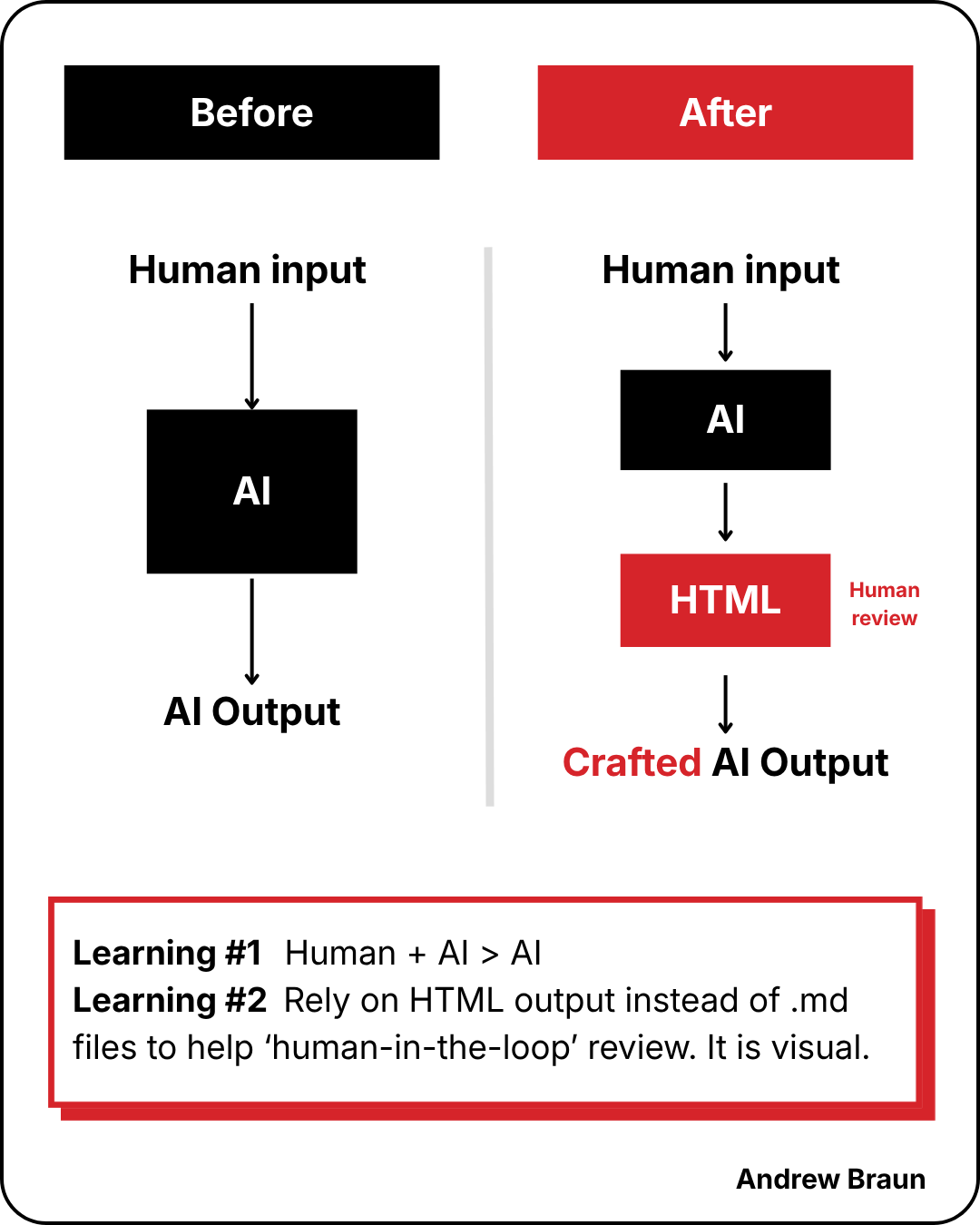
I took the human out of the loop, then had to put one back, and the hard part was not the gate. It was building the surface that makes a person's judgment worth having. Here is where I started, where I ended, the two moves in order, and what it taught me.
The first version of Soundtrak's AI Studio, an AI marketing & sales system, had no human in it, and that was the point.
Brief in, marketing campaign out. I fed a one-paragraph objective and Claude.ai handed back the whole thing: the marketing strategy, three design concepts, and every marketing asset. I entered the brief, I saw the output, and in between there was nothing but the machine. The whole run lived in a Claude.ai chat window. It was quick and it demoed beautifully. Watching a full campaign fall out of a single paragraph is the kind of thing that makes a room go quiet, makes a person believe that AI can solve for everything. But I knew better. I knew that although impressive, it was only about 80% there.
Where I started
A marketing campaign is not one decision, it evolves. It is a strategy call, then an insights call, then a creative concept call, then dozens of copy and design calls stacked on top of each other, each one leaning on the one before it. When the whole run comes back finished as a single-shot output, you aren't judging a campaign, you are judging the last thing in a chain that you never watched being built.
That is where a clean loop fails: a single misinterpretation by the machine, a wrong customer insight to lean on, an imperfect key message, or a costly channel you have no budget for, compounds. And by the time the marketing or sales assets are created it is baked into every one of them, all internally consistent, all expertly produced, and all confidently wrong.
The first iteration of the AI Studio had this problem. It had no moment where a person who knew better could put a hand up and say "no, not that." There was no way to evolve the initial objective, the single shot, and feel your way as more information presented itself. There was no way to make subtle adjustments or pivot.
Where I ended
The fix was obvious, put the human back in the loop. No marketing asset ships without a person reviewing it and approving it. That was the easy half, and if you are wiring AI into your own go-to-market it is probably the half you have already done. It is the half everyone does, because it is the one everyone thinks of first.
The half almost everyone skips is the one that turned out to matter.
A human gate is worth nothing if the human cannot actually review the thing being gated. And you cannot meaningfully review a sophisticated campaign from the raw output of AI, there is just too much data. Open an AI transcript containing a marketing strategy, three creative concepts, and forty produced assets scrolling past as walls of text and context, and tell me you are exercising judgment. You are not. You are skimming, nodding, and clicking approve (and approve), because reading all of it properly would take longer than doing the work yourself. You are the rubber stamp, kidding yourself that a human is in the loop while the human is really just present.
The second move, the one that took the actual work, was to build an operator surface, a visual HTML structured interface where the person could review and make good decisions, rather than a firehose of unstructured output, often a .md file. Every output now arrives as a purpose-built HTML interface, not a transcript. The campaign brief, the customer insight, the creative design with moodboards, the marketing plan, every asset, and the roll-out strategy. The strategy comes on one page you can read in minutes. The three creative design concepts sit side by side so you can compare them rather than scroll past them. And every finished asset comes as its own review card, the copy and the visual laid out together, all in a visual HTML for review, or approval.
Claude.ai (the machine) is the interface to change, evolve, debate (or even argue) and approve, the HTML visual interface is the way to review.
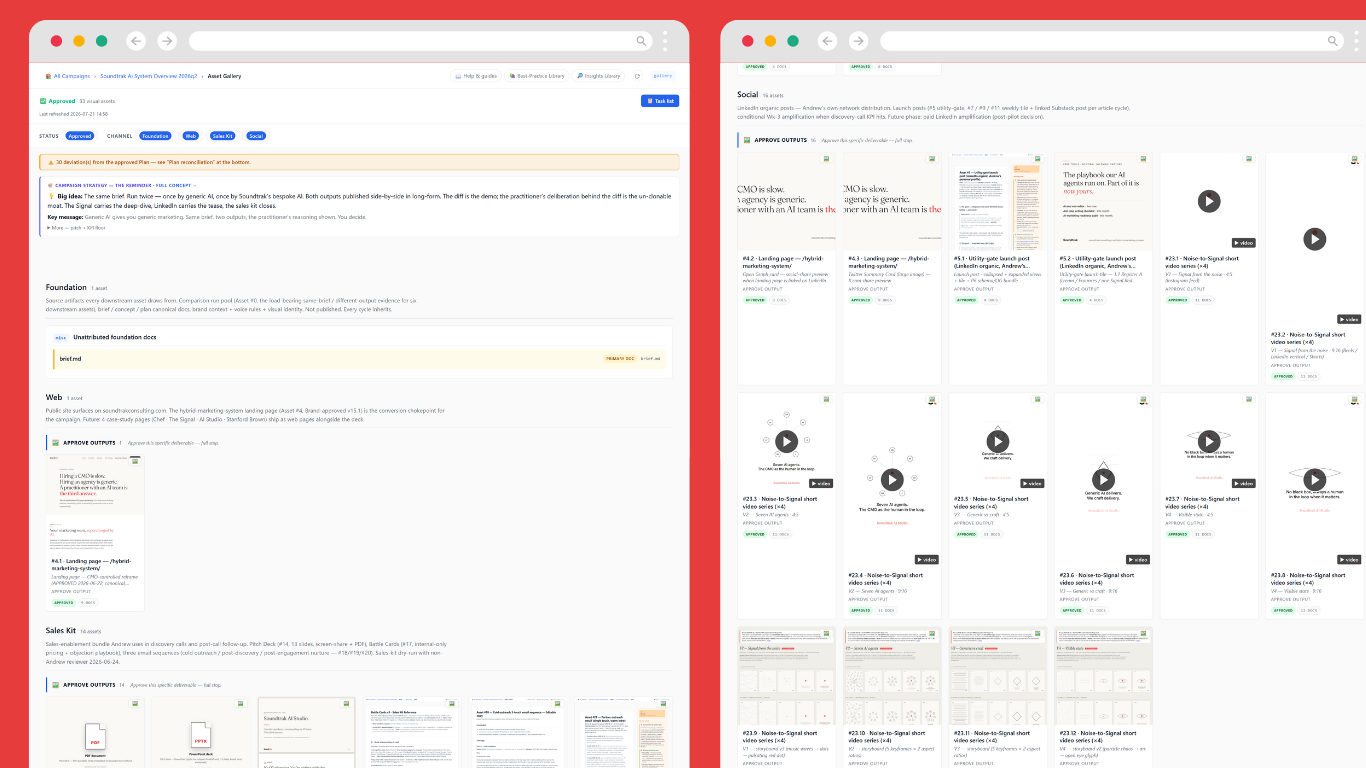
The asset gallery. This is the interface a human uses to approve, change or send back every asset, built underneath the human gate. Every "for review" badge marks a decision a person still has to make; the "approved" ones are already signed off. This is not a mockup.
Look at what the HTML screen is doing. It is not showing you a transcript and asking you to trust it. It is grouping forty decisions into a shape a person can hold.
What it taught me
The system now pauses and asks before it commits, instead of running to the end and presenting a finished thing. First, the uncontroversial one: a human and an AI, working the same problem, beat the AI on its own. Not because the human out-thinks the model on any single line, but because the human catches the half-degree strategy error before it compounds into forty assets, and brings the taste and the context the model has no access to, while the model does the volume the human never could. The human is not there to do the work the machine already does well. The human is there for the part the machine cannot see. Keep the person in the loop. That much is not in dispute, even if it is tempting to skip for the clean demo.
Second, because the gate on its own overwhelmed me, I built an HTML interface layer surfacing the right amount of information for every kind of decision, so I did not have to rely just on a transcript. A human cannot meaningfully review a sophisticated campaign from the raw output of an AI machine. There is too much of it, too interdependent, moving too fast. So if you are putting a person back into an AI process, do not stop at the gate. Build the surface that makes their judgment easy to apply.
The gate was the obvious part. Everyone reaching for AI knows they should keep a person in the loop. The part I had to learn by building it is that the person in the loop is only ever as good as what you put in front of them. So the interface stopped being a nicety, and became the thing that makes human-in-the-loop function at all.
That is the difference between a human being technically in the loop and a human being worth having in the loop. The gap between those two things is entirely the HTML interface, and the interface is not decoration on top of the AI.
The evidence
- Started: a clean loop with no human in it. Brief in, marketing campaign out.
- Ended: five human gates, and a purpose-built surface for approval.
- Changed: two moves in order, the gates, then the HTML interface layer.
- Learned: a human plus AI beats AI on its own.
- Learned: AI transcripts are too voluminous to review; HTML interfaces make the judgment possible.
- Dated: May 2026.