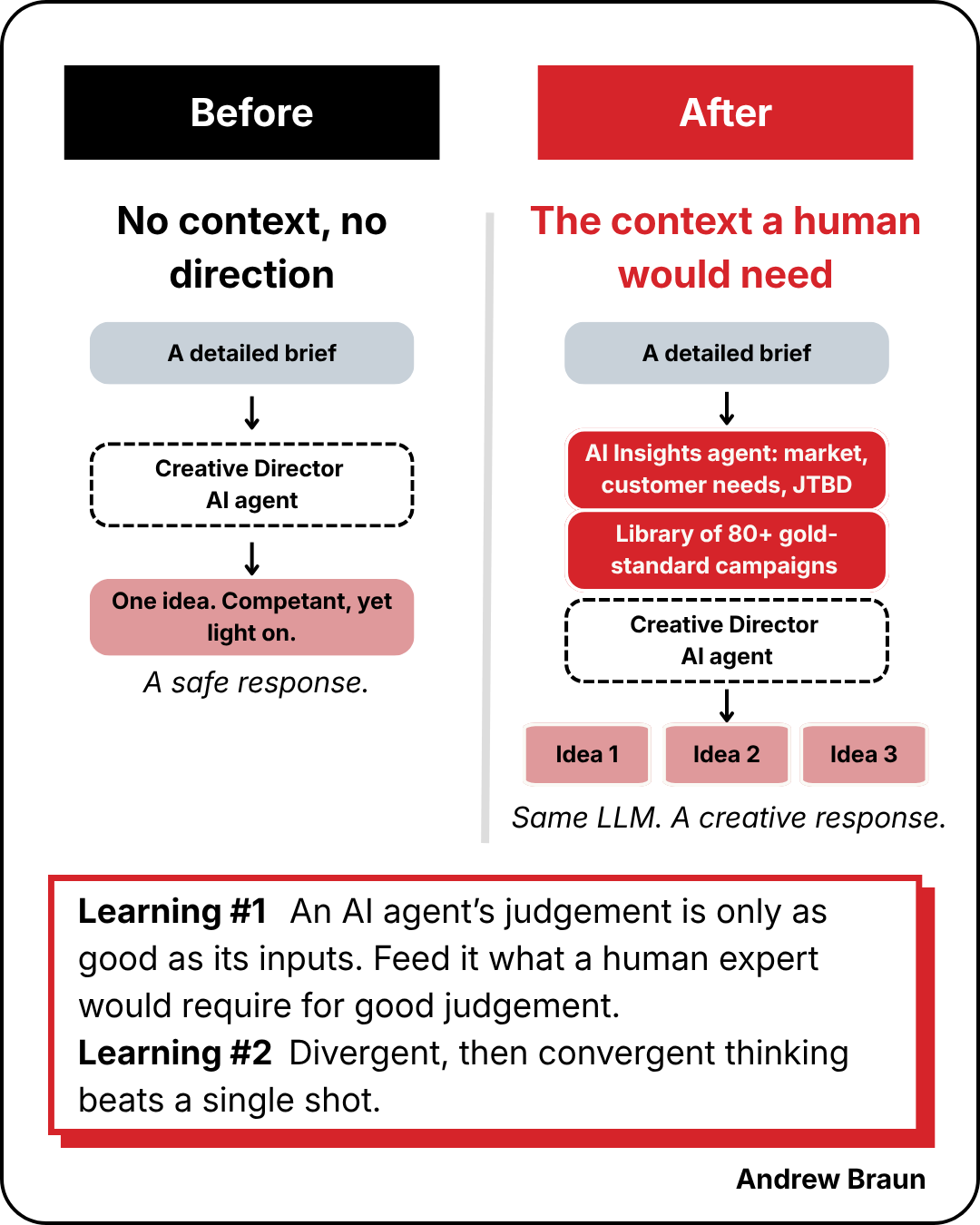
A creative director does not pull ideas from nowhere. They use research, have a read on the market, lean on the best work of others. Here is where I started, where I ended, and what it taught me.
Where I started
The first Creative Director agent in the AI Marketing Studio had one job: read the brief, return a big creative idea. It did exactly that. I would hand it a business objective and it would hand me back a concept, cleanly written, but lacking. A good idea, not great.
Like most, I wrote longer prompts and piled on instruction. I told it to think like the best creative director alive, reference Cannes winners, think like a madman. The ideas got wordier without getting better.
So I reflected on the best creative people I have worked with, and where they would start. They have read the market. They know who the target market is. They understand what those people are trying to get done, and what they have already tried and rejected. They carry a mental library of the best campaigns of the last twenty years. They have an eye for detail. The creative idea itself is the last five per cent. The other ninety-five is the inputs.
My creative agent initially had none of that. I had asked a creative director to do the job with no context. No insights, no research, no reference library. Of course it provided a safe idea.
Where I ended
I stopped trying to make the Creative Director cleverer and instead gave it more context, and evolved how it should attack the challenge.
First, I created an AI Insights Manager. Before the Creative Director agent ever sees the brief, a separate agent researches the market, who the target actually is, the needs the offer meets, the jobs the buyer is trying to get done, and a live web search for any research specific to that market and that offer. This arrives as its own document, sourced and dated, and is given to the Creative Director alongside the business brief, two documents, so the Creative Director doesn't start cold. It now starts the way a creative starts, with a point of view about the audience.
Second, I gave it a reference library. A gold-standard library of sixty to eighty of the best campaigns I could find, the ones a good creative carries around in their head. Now the agent draws on real precedent instead of a vague sense of what an ad or campaign is meant to sound like. It can reason from "this mechanic worked here, and here is why" instead of reaching for a cliche.
Then I changed the thinking itself. Instead of one cold attempt at the answer, I made the Creative Director think through a divergent then convergent pass. Diverge first: generate as many ideas as it can, deliberately wide, no editing, no taste applied yet. Then converge: filter that pile down to three big ideas (safe, smart and wild), each one built to be evolved with me rather than admired and filed.
The difference was not subtle. The same agent, on the same brief, went from one forgettable idea to three I actually wanted to debate and discuss. Nothing about the model had changed; everything about what I put in front of it had, and what I asked it to do.
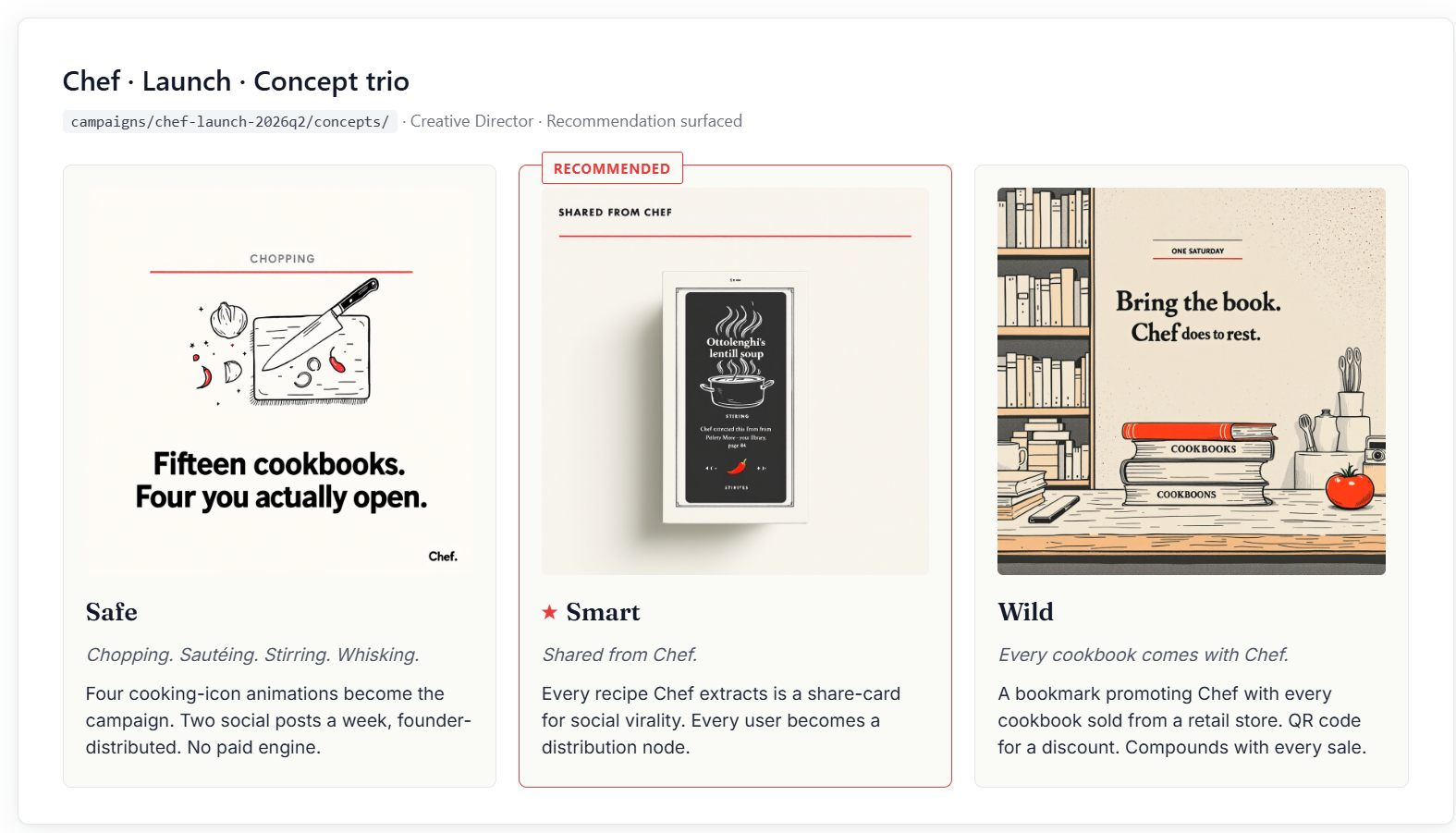
Three AI-produced creative directions with a recommendation, for the senior marketer to review. Three big ideas laid out side by side to compare.
What it taught me
The lesson is one of context. An AI agent's judgment is only as good as its inputs.
If you are wiring AI into your own work, think about this. When an agent gives you a thin answer, the instinct is to rewrite the prompt, swap the model, pile on more rules. Sometimes that is the fix. More often the agent is doing competent work with nothing to work from. Ask what a good human would need in front of them before they attempted the same task, the research, the audience read, the reference examples, and then ask whether your agent has any of it. Usually it does not, because feeding an agent is duller and harder than prompting one, so we skip it.
The second half of the lesson is the framework. Even a well-fed agent, asked for the answer, gives you the first answer. Force it to diverge before it converges. Make it go wide and produce the bad ideas alongside the good before it narrows to three, and keep a human on the convergence, where taste and context actually matter. A single cold attempt hides the alternatives it never generated. Three campaign candidates, built to be argued with, put the alternatives on the table where I can see what I am choosing between.
I did not build a better Creative Director so much as a better briefed one, and then I got out of the way at the right moment. The quality of what your AI system produces is often in the unglamorous work of choosing what it gets to see and how you make it think.
The evidence
- Started: A Creative Director agent asked to return the one big idea from the brief alone. Competent, and thin.
- Ended: The same Creative Director fed by an Insights Manager and a gold-standard library of 60 to 80 campaigns, then run divergent to convergent, down to three big ideas the human evolves with it.
- Changed: More and better inputs, plus a structured way to think, feeding the creative step. The model stayed the same.
- Learned: An agent's judgment is only as good as its inputs. Feed it what a human would need.
- Learned #2: Diverge wide, then converge to three. Structure beats a single cold attempt.
- Dated: 2026-07.