In 2011, Airbnb hired a Pixar animator to storyboard every moment of a guest's journey, from the first Google search to waking up in a stranger's home the next morning. They called it Snow White, after Walt Disney's practice of storyboarding emotional peaks before a single frame of film was drawn.
Fifteen frames for the guest journey, fifteen more for the host. The exercise was meant to help the product team understand what they were building. What it revealed was that Airbnb was paying almost no attention to the offline experience, which was most of what actually mattered to guests. The original idea, let people rent their spare rooms, wasn't wrong, it was just incomplete until detailed execution revealed what the experience actually needed to be. (Fast Company)
That pattern, an idea refined, reshaped, and ultimately defined by the decisions made during execution, is how most good products or services are actually built.
The model most organisations are running
The executive team spends weeks on strategy debating frameworks that fill whiteboards, the market gets mapped, a clear positioning emerges. Then the strategy goes to the people who have to deliver it.
The assumption in that handoff, almost never stated but almost always present, is that the hard thinking is done. What follows is execution: delivery, implementation, the operational work of turning a good idea into a real thing. Important, but not strategic work.
That assumption is wrong.
The separation of strategy and execution runs deep in how most organisations think about work. Strategy is the upstream function: defining direction, setting priorities, allocating resources. Execution is downstream, delivering against those choices with discipline and consistency.
This model has a certain logic in that it suggests clean accountability, and implies the expensive thinking happens before the expensive doing. And it appeals to people who like strategy precisely because it positions strategy as something distinct from, and prior to, the hard work of delivery.
It also produces organisations where the most consequential decisions get made by people who are furthest from the evidence.
Where strategy actually lives
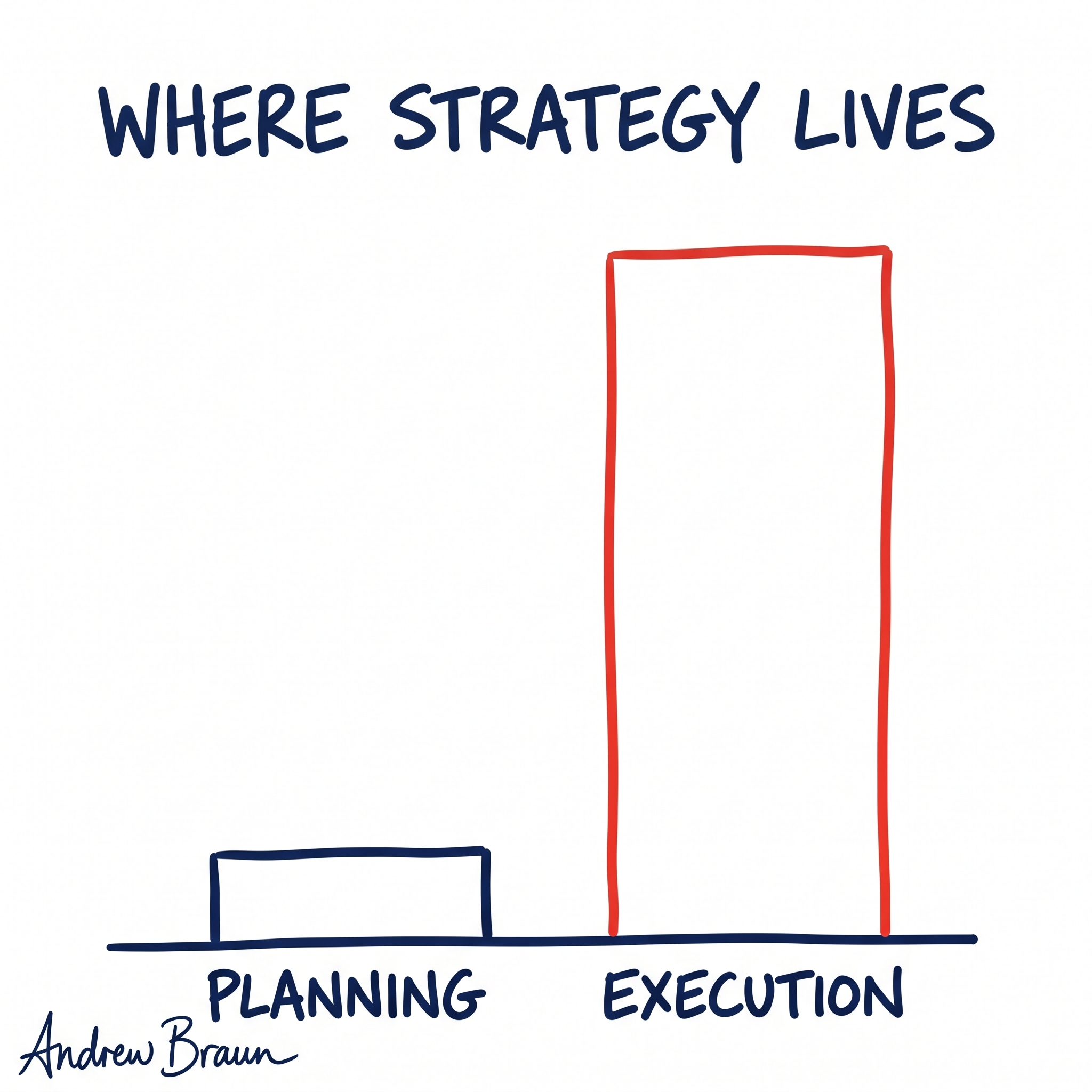
Strategy isn't a phase but a continuous series of decisions about where to direct limited resources, what to trade off, and what constitutes success. Those decisions don't stop when the initial strategic brief is written, rather they intensify.
Every A/B test you design is a strategic hypothesis. Every decision about where to direct budget when something unplanned happens is a resource allocation call. Every judgment about what to change when a campaign underperforms, and what to hold, is a bet on the theory of change underpinning the whole initiative. None of this is operational detail, but strategy, running in real time through the stages of execution.
The strategic brief answers one question: where are we going? Execution answers a hundred questions about how to actually get there. Those hundred questions are strategy.
People who love strategy and avoid execution on the grounds that the real thinking is done are opting out precisely where their skills would matter most. The micro-strategic decisions made during execution, the ones nobody calls strategic because they happen too fast and too far from the whiteboard, are often where outcomes are won or lost.
What this looks like in practice
James Dyson built 5,127 prototypes before arriving at the vacuum cleaner that worked. Each one was a micro-strategic decision about what to change, what to hold, and what the outcome actually needed to be. The original idea, a bagless vacuum using cyclone separation, was sound from the start. The 5,127 iterations were the strategy. (Gizmodo)
Booking.com runs more than 1,000 concurrent A/B tests at any given time. Their product and engineering teams make hundreds of decisions per day about what hypotheses to test, how to interpret results, and what to change. These aren't operational decisions made by people following a strategy set elsewhere. They are strategic bets made continuously through execution, about what drives conversion, what trade-offs are worth making, what the product should prioritise next. The original idea, make it easy to book a hotel, is still the idea. The execution has never stopped refining what that means.
At Netwealth, the AdviceTech Research programme didn't emerge from a planning session with a ten-year roadmap attached. The annual "deep dive" theme wasn't in the original brief. It was a strategic call made in year two, when the team recognised that longitudinal tracking data alone wouldn't sustain a compelling story year over year. That decision, recognised mid-execution by people paying close enough attention to act on it, changed the programme's longevity.
The failure version of this story is just as instructive.
Google Glass had a genuine idea behind it, and the technology was real. But the execution didn't build in the feedback loops that would have forced the hard strategic questions, who is this actually for, in what context, at what price, while the product could still be changed.
An idea is only as good as its outcome, not its ambition, not the quality of the brief that defined it. And outcomes are rarely what the original idea imagined.
If you apply one thing from this 🛠️
Ideas only become outcomes through a chain of decisions, most of which happen after the brief is written. Five things worth building in:
- Define the outcome in one sentence before the work starts, not after it ends. If the team can't agree on what success looks like at the outset, every decision made during execution will be made against a different invisible standard.
- Treat mid-execution decision points as strategic moments. When something unplanned happens, budget shifts, a test fails, the market moves, the response is a strategic call, not a project management problem. Name it as such and make it deliberately.
- Build in fast failure cycles. Don't wait for the final outcome to learn. Design the smallest possible test that can tell you whether the direction is right, run it quickly, and adjust. The goal isn't to avoid failure, it's to make failures cheap and fast so the strategic learning compounds.
- Don't treat the first outcome as the final one. Airbnb's first outcome was a website where people could rent their spare rooms. The product that exists today is the result of thousands of subsequent execution decisions. An outcome is information, not a destination.
- If you're drawn to strategy and tend to step back from execution, get involved in the execution. The most interesting strategic thinking doesn't happen in the planning room but happens when the plan meets reality and someone has to decide what to do next.
The fair objection
Organisations should have distinct planning and delivery functions. A clear outcome or target market or vision defined upfront really does make execution sharper because, at scale, a team focused entirely on execution can lose sight of direction. The strategic planning matters.
But the argument isn't that strategic planning is wrong, it's that treating it as the end of the strategic thinking is wrong. The organisations that wall off strategy from execution most completely tend to produce strategies that don't survive contact with reality, not because the strategists thought poorly, but because execution surfaces information that no planning process can anticipate. The people doing the work know things the people writing the plan don't.
Every strategic plan is just the first version of the real work.