For twelve years at Netwealth I had an unusual vantage point. I ran the direct-to-consumer business, B2B marketing, and the software’s UX. Most marketing leaders own a slice of the customer. I influenced a big chunk of the journey, from the first time a prospect ever saw us to the day they used the software and decided to stay.
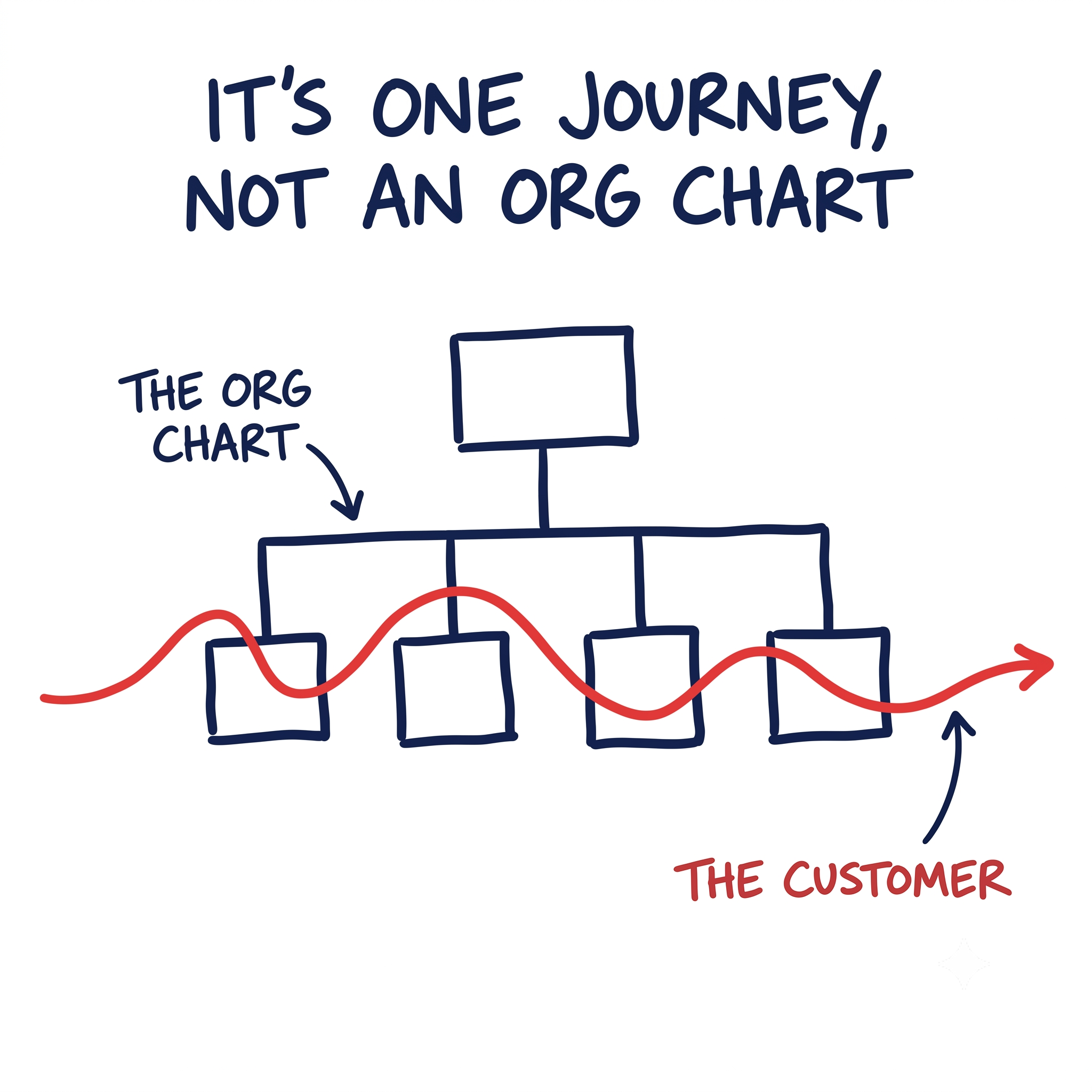
When you have visibility over so much of the journey, one thing becomes obvious fast. The customer never experiences your business the way your org chart is drawn.
Every company is built as a set of functions. Marketing, sales, product, call centre, each with its own team, its own metrics, its own incentives, its own internal logic. We structure a business like that for good reasons, specialists often do better work than generalists, and reporting on their output, in silos, is easier to account.
Nobody owns the gaps.
The trouble starts when growth stalls or customer satisfaction declines, and everyone goes looking for the problem in someone else's lane. Marketing says the leads are fine and sales can't close them. Sales says the leads are junk. Product says nobody told them what to build. The call centre says they are meeting their SLAs. Each team is performing adequately inside its own boundary, and revenue is leaking and satisfaction declining out of the gaps between them.
It can also happen when looking to kick off new initiative that is truly cross-functional. Who should own it? Which team has the capacity to run it, the capabilities to make it successful.
The customer experiences none of those boundaries. They experience one continuous arc of your business: first impression, consideration, decision, onboarding, ongoing use, training and support. To them it is a single business. When the handoffs between your functions are misaligned, it shows up as stalled conversion, unexplained churn, or a brand that promises something the product never delivers.
This is not a soft observation. McKinsey studied it across industries and found that performance on complete journeys is 30 to 40 percent more strongly correlated with customer satisfaction than performance on any individual touchpoint, and 20 to 30 percent more strongly correlated with the outcomes that actually pay the bills, repeat purchase and low churn.
You can have six teams each hitting their numbers and a customer journey that leaks money and satisfaction at every seam.
Understanding the entire customer journey
Tony Fadell is, widely known as the "Father of the iPod" and the co-creator of the iPhone in his recent book ‘Build: An Unorthodox Guide to Making Things Worth Making’ emphasises that when building something, you are building a customer system, not just a feature, product or service. The iPod wasn’t successful just because it had great hardware, but also because of the ITunes store. The iPhone wasn’t successful because of its touch screen, but also because of App store, the developer network, and the mobile 3G ecosystem.
Another example he offers is Nest, an AI-driven home thermostat, purchased by Google in 2014 for over $US3b. Previously thermostats needed to be installed by a professional, but Nest was available to buy at retailers like Best Buy. Home surveillance video kits have followed a similar trend. Both demonstrate that by removing the installation friction from the customer journey, you can grow a market.
He goes further, and suggests that marketing = product, rejecting the idea that marketing (and sales) is a separate department from what the engineers make.
“Marketing is part of the product because it sets the customer’s expectations before they even buy.”
If you apply one thing from this 🛠
- Map the customer journey end to end. Find the handoffs: marketing to sales, sales to onboarding, onboarding to service by putting the people who own different stages in the same room.
- "Fall in Love with the Pain": One of Tony’s core mantras is that you must obsess over the customer's pain (e.g., a freezing house, a confusing interface), not your solution.
- If you are building something new, write the press release before you build it (or design the retail box). If you cannot tell a compelling story about why it needs to exist to a stranger, maybe it doesn’t matter.
- Build the ecosystem, not just the product. Ask what has to exist around the thing you are making for customers to adopt it easily: distribution, onboarding, partners, training, support, integrations and proof that it fits into their world. Often the breakthrough is not a better feature, but removing the friction around it.
- Build shared metrics no single function can game alone: pipeline velocity, customer lifetime value, net revenue retention. What you measure together, you fix together.
The fair objection.
A sharp operator will push back here. Functions exist for a reason. If everyone owns the whole journey, nobody really owns anything, and you lose the depth specialists bring. That is a real risk, and I am not arguing for dissolving the teams.
Keep the functions and the specialists. What is usually missing is not another team, it is a single accountability for the arc that runs across them, and a set of shared numbers no one function can hit on its own, a person who has the expertise to see the entire journey and who has business influence to course correct. The point is not that everyone owns everything. It is that someone owns the seams.
The most common growth problem I see is not a weak marketing program or an underperforming sales team or long wait time in call centres in isolation. It is a business system where every function is fine and the whole thing still underperforms.
You do not fix a leaking journey by making each team a little better at its own stage. You can run that programme for years and watch the numbers barely move, because the loss was never inside the stages. It was in the space between them.