Throughout the 2026 Australian Open tennis, an ad played. Jim Courier acting as a courier delivering food, a performance for Uber Eats, that had me and the kids in hysterics (and probably half the country sharing it on YouTube). For the minute it ran, it wasn't an interruption to the broadcast, it was part of the entertainment.
Uber ran the same advertising break as a dozen other companies, to the same audience, with the same reach. The difference wasn't spend, it was utility.
What most marketing is doing
Most marketing operates on a simple premise: the job is to communicate about the product or service. So teams create content that explains features, run ads that list benefits, host events that demonstrate the product. The audience is the recipient, but the message is about us.
This is defensible. Budgets need justifying, sales teams need equipping, so marketing that talks directly about the product is easy to justify and maybe easier to measure.
It is also largely avoided by your audiences who have developed well-calibrated filters for content and advertising that doesn't serve them. How many times have you personally glazed over a display ad on a website, ignored a billboard whilst driving, turned to your mobile phone during a TV ad. You aren't alone.
The question that changes your approach
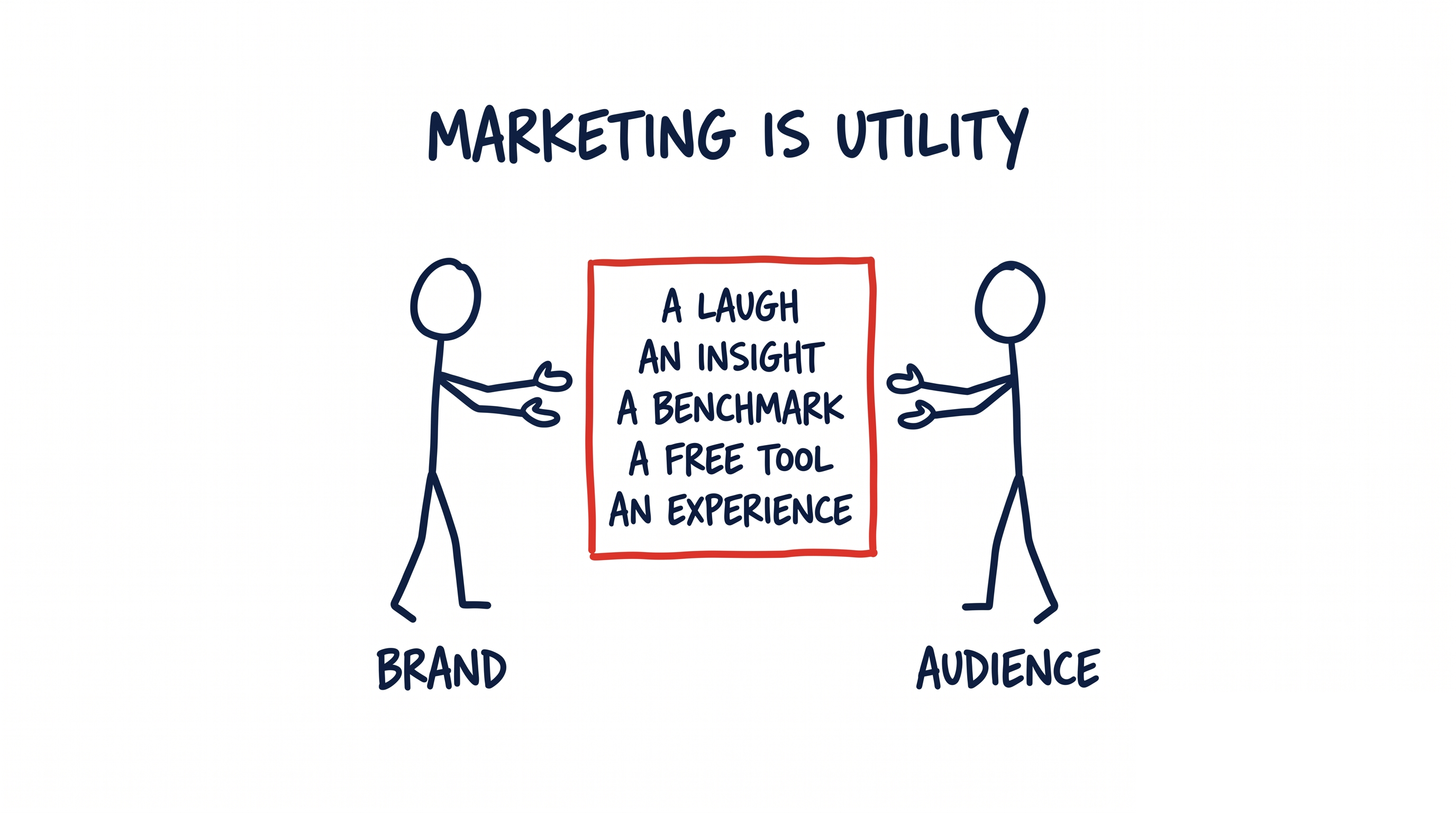
Teams that treat marketing as a 'utility' start with a different question. Not 'what do we want to say?' but 'what do we want to give?'
The best marketing isn't a message the recipient tolerates, it's something they sought out, shared, saved, or came back to. A laugh. An insight they couldn't get elsewhere. A benchmark that helped them make a real decision. A free tool. An experience worth having. The gift can take many forms.
The best marketing doesn't feel like marketing because it isn't, really. It's an act of giving.
What it looks like when it works
At Netwealth, we applied this logic to our B2B marketing efforts by creating a valuable resource for our audience of wealth professionals. We surveyed 300+ financial advice firms annually and published research no one else had. The AdviceTech Report wasn't created to talk about our platform. It was created to answer questions advisers were already asking: which technologies are leading practices adopting? What are the trends? Where are my gaps? What does good technology stack look like?
Advisers read it, shared it, and cited it in their internal presentations, not because it mentioned us, but because it was useful to them. The brand association was real and durable, but it followed the value (or utility). Advice firms who eventually moved to Netwealth had often been reading our research for years before they were in a position to switch. Utility built familiarity in a buying cycle measured in years, not clicks.
Instead of just telling people IKEA furniture will work in their home, IKEA built an AR (Augmented reality) tool that lets customers see true-to-scale furniture in their actual room before buying by using their phone. Here marketing is doing a job for the customer: reducing uncertainty, helping decision-making, and lowering the risk of a bad purchase. In other words, it's not just persuasion, it's service. (Source)
Utility marketing is when the brand stops describing value and starts delivering it directly.
Other examples include:
- Nike Run Club: An app that gives runners tracking, coaching, goals, and community, so marketing becomes an ongoing fitness utility, not just shoe promotion.
- Home Depot workshops: In person and online they teach people how to complete projects, which helps reduce intimidation and increase customer capability.
- Spotify Wrapped: Spotify turns a year of listening data into a personal recap people actually want to see and share. It gives users reflection, entertainment, and social currency, not just a message about the brand. The utility is emotional and participatory rather than practical, but it still adds real value to the user experience.
- Intuit's tax tools: Instead of just promoting tax software, Intuit offers free calculators and estimators that help people understand refunds, withholding, tax brackets, and deductions. The brand earns attention by helping users solve a stressful problem upfront.
- Harley Owners Group (H.O.G.): Harley-Davidson's Riders Club is another form of utility marketing — a membership where Harley owners have access to events, mechanical support, and the wider community around the act of riding.
- Dollar Shave Club launch video: A simple video with the founder standing in a warehouse, talking directly to camera, making jokes about razors and the absurdity of the category. It cost very little to produce, but people chose to watch it, share it, and come back to it because it was genuinely entertaining. The utility wasn't functional, it was a laugh — and the business followed, leading to a sale to Unilever for around $1B.
If you apply one thing from this — The 'Utility' audit 🛠️
Before building any marketing campaigns, run the utility audit before the next planning cycle.
- Before approving any content initiative, answer the utility question specifically: what exact value does this give your audience, in their business and professional context, that they couldn't easily get elsewhere?
- Which utility type are you delivering: entertainment, education, a tool, original research, a peer-networking opportunity, or time saved? Choose one deliberately, not by default.
- Design for the customer's context. A time-poor sales person in back-to-back client meetings has a different consumption window than a marketing professional at a desk. Format and length follow from that, not from what's easiest to produce.
- Does the utility align with your brand positioning? A wealth platform creating technology research is credible and aligned. The same platform running cooking content is not.
- Offer variety. Some audiences engage with long-form analysis. Others only consume short-form, visual, or audio content. If you're producing only one format, you're serving a subset. The same technology insights in a podcast format becomes consumable on a commute. A 50-page report should generate a keynote, a newsletter series, social content, and sales conversation starters.
- Run the utility audit on your existing content library. How much of it would your audience choose to consume? What would they miss if it disappeared? The answer tells you what to double down on and what to stop.
- Treat major content programmes as products: assign a dedicated owner, build an editorial roadmap, and define success metrics beyond open rates, including feature adoption, pipeline initiated, and support ticket reduction.
- Map utility to the stages of the customer journey. Awareness-stage audiences need different value than retention-stage customers. Don't serve the same content to both.
The question before the next brief isn't whether the creative is strong or the targeting is sharp. It's whether the person at the receiving end is getting value.
The fair objection
The reasonable objection is that a laugh doesn't fill the pipeline or lead people to a checkout, an insight doesn't close a deal.
True. But the Jim Courier ad sold Uber Eats. The AdviceTech research was category creation that compounded into sales conversations over eight years for Netwealth.
Utility and commercial intent aren't opposites, they are part of the same soundtrack.
Marketing that leads with messaging about features of the product and service hoping the audience finds it useful tends to be wrong in that order. To lead with an offer can be useful for people who are in market buying, but to lead with a utility helps your future buyers, people not in market but will be.
Every piece of marketing either gives the recipient something or takes something from them: their time, their attention, their patience. The marketing that earns lasting brand positions tends to be the kind people sought out, shared, and came back to without being asked.