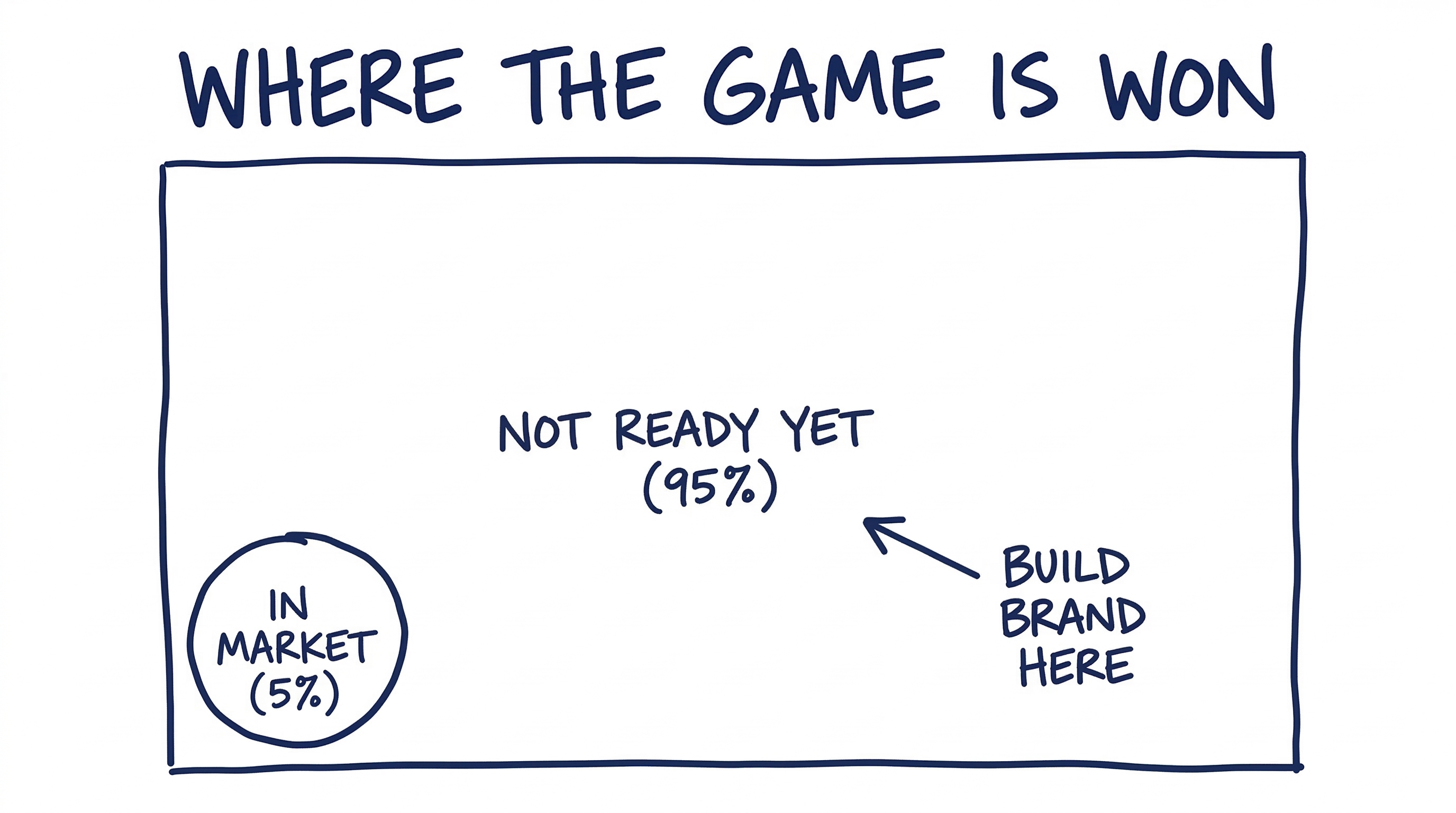
Byron Sharp's research, and years of B2B market experience, points to the same inconvenient truth: the vast majority of people who will one day buy from you are not ready to buy right now. They have a vague awareness of a problem. They're in the early stages of a journey that might end in a purchase decision six, twelve, or twenty-four months from now.
Performance marketing - search, paid social, retargeting - is extraordinarily good at reaching the 5% who are in-market today. It is near-useless for the 95% who aren't. And here's the structural problem: if you only invest in performance, you spend your entire budget fighting for the same small pool of active buyers, mostly against competitors who are doing the same thing. You're competing on the last mile while ignoring everything that happens before it.
At any given moment, 95% of your addressable market is not in-market. Performance marketing reaches the 5%. Brand marketing wins the 95% before the conversation starts.
What brand marketing actually does
- Builds mental availability - the probability that your brand comes to mind when the buying moment arrives
- Creates a consideration shortlist before the prospect even knows they're building one
- Reduces the cost of the performance moment - if someone already knows who you are, you need less convincing, fewer touchpoints, and a lower CPA
- Compounds over time in a way that paid reach does not
What this looks like in practice
At one of Australia's leading wealth management platforms, the competitive set was, on paper, nearly identical. Features, pricing, and performance had converged across the category. The research we ran over eight years - surveying 300+ financial advice firms annually - consistently showed that brand perception and technology leadership were the primary factors when advisers made platform decisions.
Not the product itself. The reputation that preceded it.
The brands that won weren't running better paid campaigns in the weeks before an adviser decided to switch. They were the ones advisers already had a relationship with - through research they'd read, podcasts they'd listened to, events they'd attended. By the time someone picked up the phone to explore a change, the shortlist was already formed. Performance marketing couldn't build that. The party was already underway before anyone put out an ad.
Common mistakes
- Treating search ads as a brand strategy
- Measuring brand investment with performance metrics
- Waiting until someone is in-market before influencing them
- Confusing being seen with being remembered
- Cutting brand budget the moment revenue softens
How to apply it
- Ask: what percentage of my addressable market is in-market today? If it's less than 30%, you should be over-indexing on brand
- Measure brand separately from performance - they are different problems with different lag times and different success criteria
- Never evaluate brand campaigns with performance metrics. If you measure brand with cost-per-lead targets, you'll cut it every time the quarter gets tight. Instead look at brand saliency or sales conversation time
- Create content that earns attention from the 95% rather than interrupting the 5%
- Treat thought leadership, research, and owned media as long-term business investments, not just marketing tactics
The legitimate objection
A commercially sharp person would push back here: you can't build a business on brand while ignoring the people who are ready to buy right now.
They're right. Performance marketing exists for a reason - it converts intent. If buyers are actively searching, being visible in that moment is non-negotiable. Nobody is arguing otherwise.
The nuance is in the ratio and the sequence. Most organisations that have leaned into performance-first thinking haven't done so because brand was wrong. They've done so because brand is harder to defend in a budget meeting. The metrics are lagging. The payoff is slow. That's a measurement problem masquerading as a strategy problem.
Performance marketing rents attention. Brand marketing builds a position in someone's mind that no competitor can buy in a week, regardless of budget.