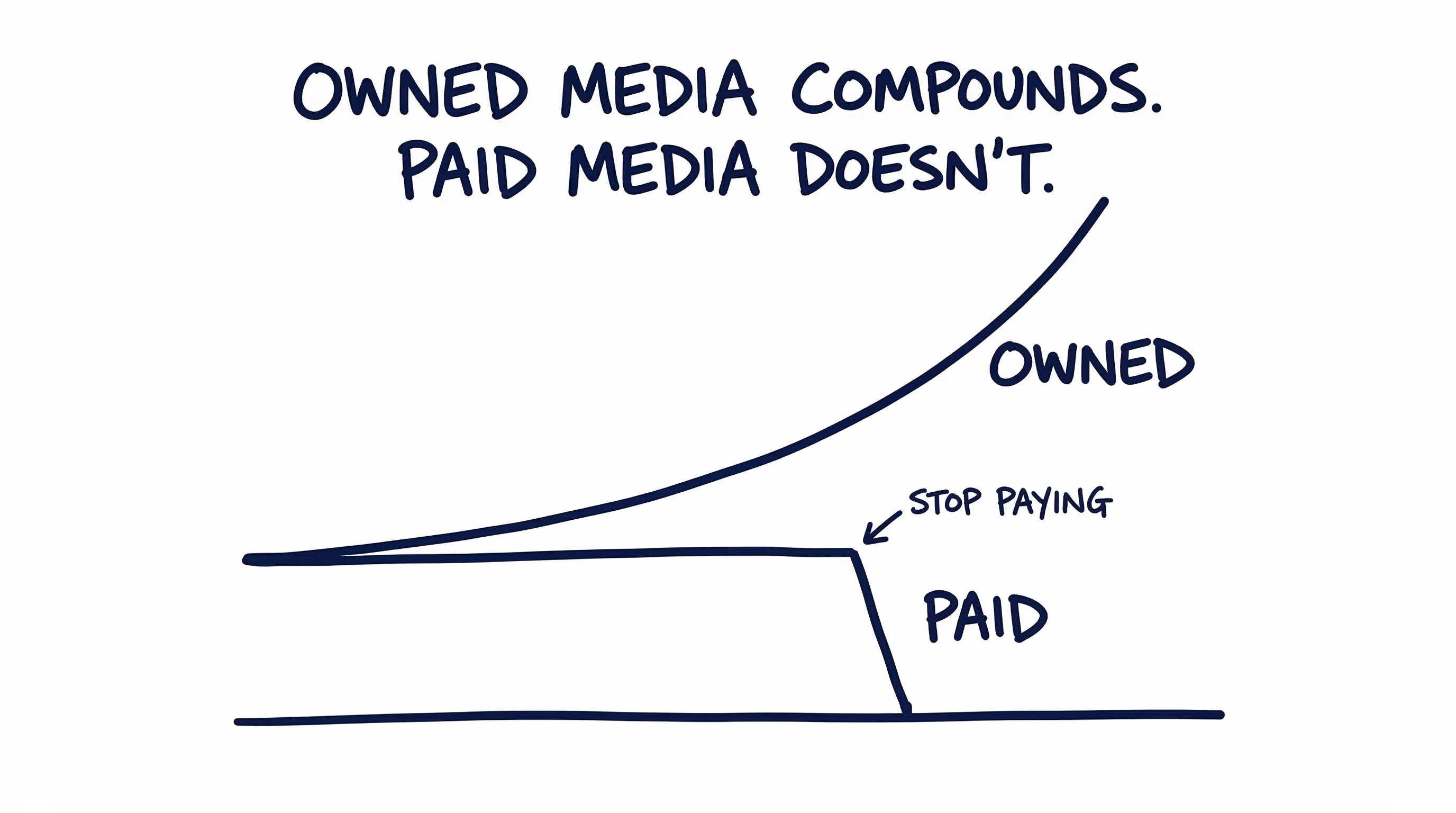
Every dollar spent on paid media produces results exactly proportional to what you spend, and stops the moment you stop. That's not a criticism - performance media serves a real and important commercial function. But it's a rental arrangement, not an ownership one.
Owned media (a newsletter, a podcast, a research programme, a content library) works differently. The first edition of a newsletter costs as much to produce as the fiftieth. But by the fiftieth edition, you have a compounding asset: an audience that trusts you, a body of work that ranks and circulates, and a brand presence that exists independently of your media budget.
The difference between a campaign and an asset is what happens when you stop paying. One goes to zero. One keeps going.
The compounding mechanics
- Each newsletter edition grows the subscriber base, which makes the next one more valuable
- Each research report generates coverage, citations, and backlinks that persist long after the launch
- A podcast library keeps accumulating SEO value as transcripts and articles compound over time
- Owned audiences give you direct access to your market without paying a platform intermediary on every send
How to apply it
- If you only have one dollar, allocate it to brand - if you're playing the long game, this is where compounding starts
- If you have a hundred dollars, over-index on brand but don't ignore performance - the mix depends on how much of your audience is in-market right now
- Think of performance marketing like a gumball machine: at some point the balls run out. Owned media is what you build so the machine doesn't need to run forever
- Ask: what percentage of my audience is in-market today? If it's less than 30%, prioritise brand and owned channels
- Brand activities that build owned equity: positioning, thought leadership, content libraries, brand advertising that educates without an immediate CTA
- Performance activities that convert intent: event registrations, ebook downloads, trial sign-ups, direct response campaigns
What this looks like in practice
At Netwealth (ASX:NWL), we were operating in a highly competitive wealth management and superannuation industry where feature sets across competitors were broadly similar. We didn't compete on price or features alone - we built brand around "seeing wealth differently" and being a technology leader.
The owned media programme we built included research reports, podcasts featuring our CEO and industry leaders, and a sustained thought leadership programme. This created mental availability: when financial advisers were ready to switch platforms, we were already in the room - because they'd been reading our research, listening to our podcast, and seeing our point of view for years before they were ready to move.
The brand didn't win the deal. It made sure we were on the shortlist before anyone issued an RFP.
Common mistakes
- Digital advertising has trained a generation of marketers into short-termism and performance-only thinking - it's measurable, fast, and easy to defend in a budget meeting. That doesn't make it the whole answer
- Treating search marketing as the primary channel - useful in B2C, significantly less so in B2B where buyers go directly to known vendors' websites when they're ready to move
- Forgetting that in B2B, in-market buyers don't Google category terms - they go straight to the brands they already know. If you're not in their head before that moment, you're not on the shortlist
- Confusing being seen with being remembered - reach is not the same as mental availability. A thousand impressions on someone who doesn't remember you served no purpose
Related concepts
- Byron Sharp's "Mental Availability" (How Brands Grow) - the research foundation for understanding why brand presence matters more than message precision for most markets
- The 95-5 Rule - 95% of your market isn't in-market buying today. Owned media is how you reach them before the buying window opens
- Seth Godin's "Permission Marketing" - the principle that earning an audience's attention over time is more valuable than interrupting it repeatedly