At Netwealth, we used to argue about features in a room full of people who would never use them. The financial adviser was not there, their client the investor was not there, and the admin team who lived in the platform all day was on another floor. So we made a rule. Before any real decision, someone had to describe, out loud, the actual human who would touch the feature: what they were doing, on what device, and what benefit they needed to walk away with. This wasn’t an acceptance test, it was much more. It changed the decisions, and it changed them in a specific direction. It redefined what MVP was - away from what was easiest to build, and toward what the customer actually needed. The surprise, if it was a surprise, was that this was also the thing that drove the business result.
"Customer-centric" is on every company's website and in every values deck. The day-to-day then pulls the other way. You design for the roadmap that was set in January, for the loudest stakeholder in the review, for the feature that will demo well, for the org chart. All of those are real pressures, and none of them is the customer (or customers). The result can be software that is full of features but misses the point, built for everyone in the building except the people it is meant to serve.
Radical customer centricity is not a persona poster or a values statement or a KPI. It is a set of hard, specific design decisions, made over and over, that put the client's outcome ahead of everything else in the room.
Amazon made the idea physical: in the early days Jeff Bezos kept an empty chair in meetings, the customer's seat, a reminder that the most important person in the decision was not in the room.
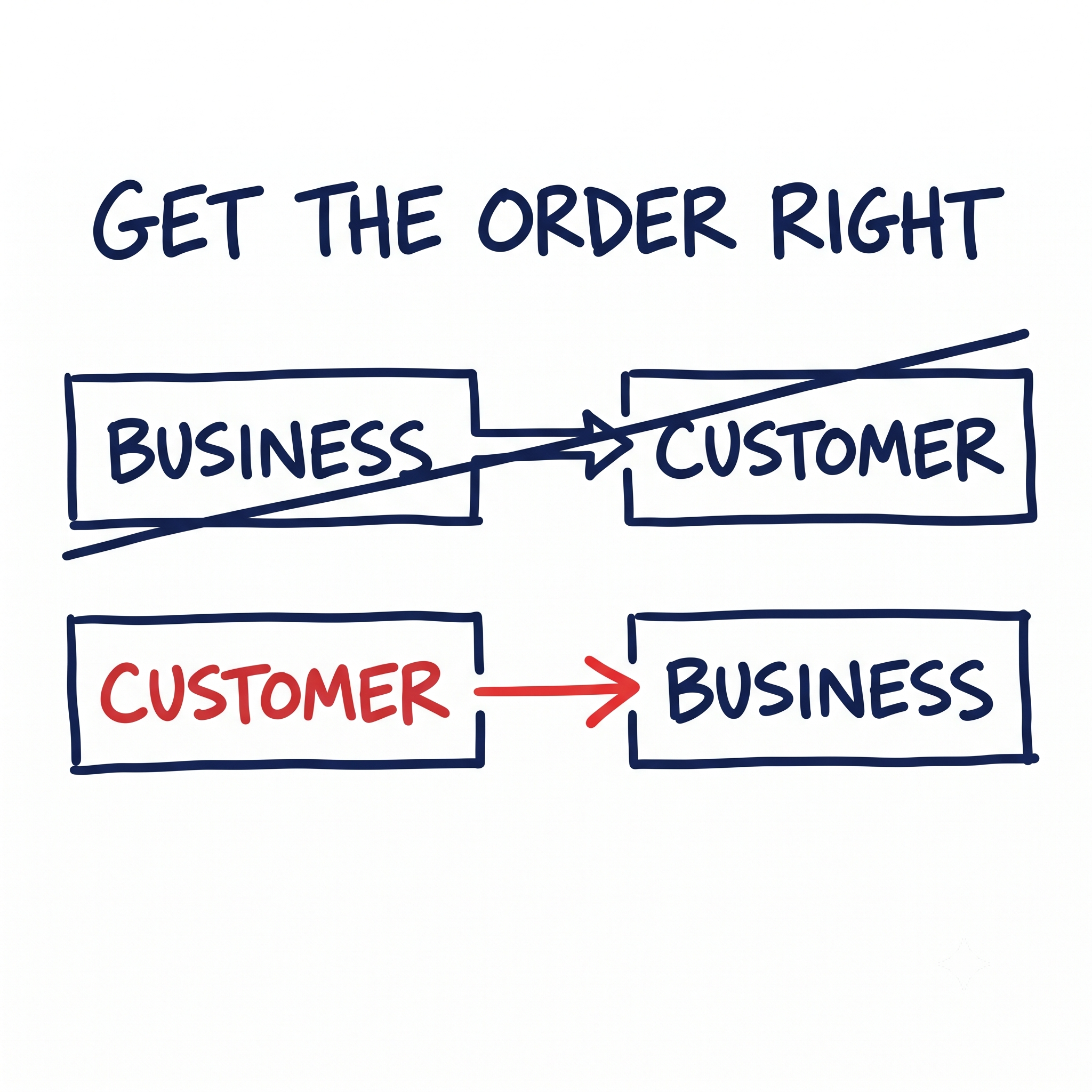
The order matters more than anything else
Put the client's outcome first and the business outcome follows from it. Reverse it, chase the business result and treat the customer as the means, and you tend to get neither.
This is not a hope, it is measured. Forrester's CX Index, across industries including wealth management, found the revenue of customer-experience leaders grows 5.1 times faster than the laggards'. A portfolio of the top CX brands beat the S&P 500 over the same period while the laggards barely moved. Bain puts the gap at four to eight percent faster revenue growth, year on year. The causation runs through the client. Better outcomes for them, then better outcomes for you.
So how do you actually do it, past the slogan? The key is to develop a set of design disciplines. Here are five, each one a decision you can make on a real product this week.
1/ Design for the ecosystem, not the individual
A product rarely has one user. Netwealth had four: wealth professionals, their clients, direct investors, and the internal admin team, each using the same platform for a different job. Design for one and you fail the other three. The discipline is to solve each group's distinct job. Get that right and no group is an afterthought, which is why all four adopt it, not just the one you happened to picture.
💡Tip: When mapping features, explicitly identify the distinct user personas and document where their goals differ or converge.
2/ Be device-first
Office workers on two large monitors and the investor checking a balance on a phone on the train are not the same screen at two widths. They are different jobs in different physical contexts. Design for the real device and the real moment and the real need, because the product fits each person differently.
💡Tip: Review device usage data by user segment to ensure design priorities match real-world behavior. Use data and don't assume.
3/ Lead research with a hypothesis
Customer research run for its own sake produces decks nobody acts on. Research that leads with a hypothesis, a specific assumption you are trying to prove wrong, produces decisions. Intuit built a whole practice on this, "follow me home," sending people to watch real customers use the product in their own kitchens and offices rather than in a lab. You end up fixing the real problem instead of the imagined one, and you stop spending months building the wrong thing.
💡Tip: Select research methods based on specific learning objectives and ensure the facilitator remains strictly objective.
4/ Eliminate cognitive friction
Clarity beats cleverness. Plain, descriptive labels instead of internal jargon or ambiguous icons, so the user never has to stop and guess. I hit the sharpest version of this building my own AI marketing system, Soundtrak AI Studio. AI will produce far more copy than any human can read, so the real design problem was helping the person reviewing it. I designed it so the ‘human in the loop’ never needs to review and approve raw AI output, instead reviews a usable, digestible HTML page. The human can now make decisions that would otherwise stall or take a while to get made.
💡Tip: Drop the internal jargon. Use plain, descriptive labels, because people scan for signposts, they don't read.
(Soundtrak AI Studio, the AI studio that 10Xs your marketing, launches soon. Link to be added at publish.)
5/ Design to usage velocity
How often someone uses a thing should decide how complex it is allowed to be. A daily power tool can reward expertise. An annual task, like tax reporting, has to be re-learnable from scratch every time, because the user has forgotten it since last year. Match the UX design to the frequency and the once-a-year user gets through on their own, which is a better experience for them and one less support call for you.
💡Tip: Make annual tasks re-learnable with no training; let daily tools reward the expert.
The fair objection
The fair objection is that customers don't know what they want. Ask them and they want a faster horse. Take radical customer centricity too literally and you become an order-taker, building whatever the loudest client asked for, slowly and expensively.
It is a fair point, and it misses what centricity actually means. Being customer-centric is not doing what the customer says. It is obsessing over the outcome the customer is trying to reach, which might be opposite of what they asked for! The investor who asks for more charts usually wants more confidence, and the answer might be fewer charts and one clear number. Radical centricity means holding the outcome fixed and staying flexible about the feature. That is harder than order-taking, not easier, and it is the version that pays back.
"Being customer-centric is not doing what the customer says. It is obsessing over what they are actually trying to achieve."
Put the client outcome first, build the disciplines that make it real, and the business result is not something you chase. It arrives, as the consequence of the client getting what they came for. There is no trade-off between the customer and the business. There is only the order you put them in.
----
The empty chair was never really empty. The customer is in every decision whether you name them or not: in the feature that helps them or the one that wastes their time, in the screen that fits their morning or fights it. The only question is whether you design as if they are in the room.
----