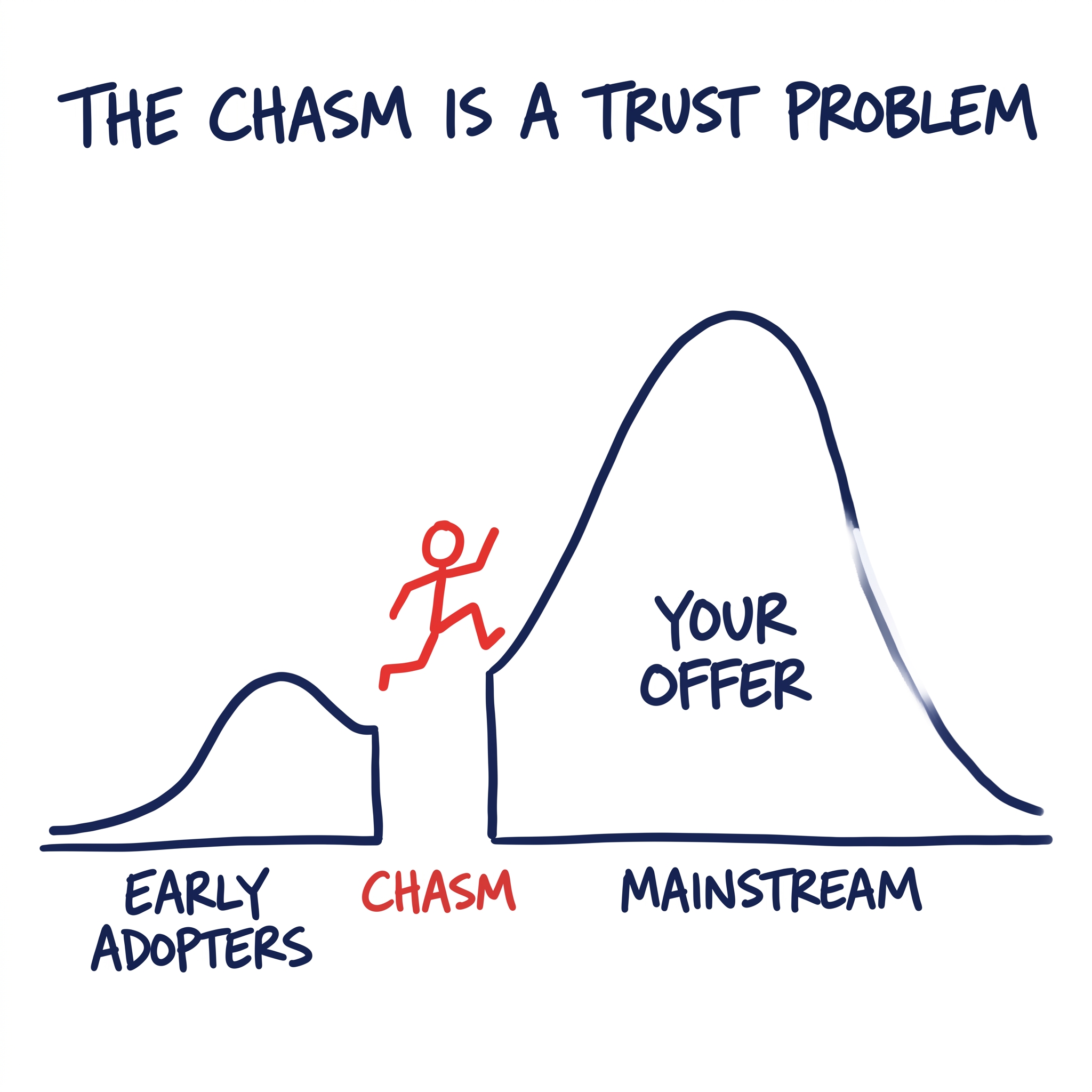
In my 20s I was fortunate enough to work at a tech start-up, during the dot-com boom, Icewrx. We had a cutting-edge mobile ecosystem play. Telcos loved it, wireless hardware companies loved it, we got some good early wins, but then we hit the wall.
We won over the people who love new things, the early adopters that are looking for the next big thing, the people who don’t mind a rough edge, the believers. But the mainstream was not on board. We were a clever and innovative technology, selling something advanced, but the mainstream were still using flip phones and mobile ring tones with the most innovative thing at the time.
Why the chasm is really about trust
That gap between early adopters and the mainstream is what Geoffrey Moore, one of my early tech idols, calls the chasm, and his book Crossing the Chasm is the one that explained to me why so many good technologies die.
It taught me that it is a different audience who buys early, and for a different reason than the mainstream, who buy later and for often the opposite reason. One is drawn to a thing because it is unproven, exciting; the other will not go near it until it is proven.
Some people think adoption of anything new is a smooth line upwards. You build something better, word spreads, you sell more. Get the product right and the market follows. It happens to some, but only a few.
Moore’s point is that the adoption curve breaks after the early adopter buys. There is a pause between when the mainstream buyer joins, and sometimes this never even happens, that is, the product doesn’t ‘cross the chasm.’ In technology businesses I have seen this so many times: Google Glass, the Segway, Apple Newton, Second Life, Windows Phone, Vine, and the list goes on.
The mainstream does not want to know what you built. It wants to know who else is already using it.
How to cross: complete the offer, then go narrow
This is where technology, the customer and business meet. You can have the latest and most innovative technology, but if you don’t recognise that the largest of your customer base are wary buyers, you will lose.
To cross the chasm and reach this larger, more cautious majority you will have to change how you present yourself: stop leading with how clever your product, technology or offer is and start leading with who trusted it. The message needs to move from “look what we built” to “look who is already using it.” When you cross the chasm, you are appealing to those who are looking for evidence. You need to become the safe choice, not the most innovative.
Moore talks about a second concept in his book, ‘the whole product’. An early adopter will happily use the solution and if it has gaps, they workaround them and fill them. The mainstream will not. They want the whole problem solved for them. This will include: the onboarding, the integration, the education, the support, the entire scaffolding around your offer that will lead to a “yes”.
A way Moore suggests building out your offer is to start with early adopters in a niche and then expand into other verticals as your offer becomes more mature, with more evidence to support the mainstream.
Proof in practice: Documentum, Salesforce and Tesla
Moore’s own example is the one that stuck with me. Documentum was a document-management company going nowhere, drifting at a few million in revenue, until it stopped selling to everyone and picked a beachhead almost comically small: the regulatory-affairs departments of big pharmaceutical companies. There were only about forty of them in the world. But their pain was enormous. A new-drug application to the regulator ran to hundreds of thousands of pages, pulled from dozens of sources and frozen as a single master document, and every day a filing was late was a day of patent-protected sales lost. Documentum solved that one problem completely, won thirty of the top forty, and only then moved out into chemicals and oil and gas. It grew from two million dollars to forty-five million in three years by going almost absurdly narrow first.
The pattern keeps repeating. Salesforce began down-market, with the small businesses the big CRM vendors could not be bothered to serve well, and climbed from there. The electric car never crossed the chasm for so long that Moore used it as his stand-in for a stranded technology across two editions of the book, until Tesla carried it over the chasm. Different industries, the same move: win one narrow group completely, earn the references, show the evidence, build the trust and then expand.
If you apply one thing from this
Read the book. And for those who are time poor, here are some takeaways:
- Build the whole offer before you court the mainstream. Assume they will assemble nothing themselves, so the integrations, onboarding and customer service have to be there, ready on day one.
- Win one narrow market completely before you reach for the next. A beachhead small enough to own and specific enough to dominate. It builds out your offer, and creates references to establish trust with mainstream buyers.
- Lead with proof. A cautious buyer is reassured by existing clients, so put the reference customers and the peer names where the specs used to be.
- Choose the segment by who you can make completely successful, ahead of who is the biggest. One customer you make a total success is worth more than ten you half-serve, because the first sells the next for you.
- Change your messaging as you move from early-adopters to mainstream: lead with cutting edge, then shift to reassurance.
The fair objection
The book is from 1991 and was written for enterprise software you installed on your own servers, before platforms and network effects rewrote the rules, and before products cleared the chasm now on social proof alone where a wave of people online vouching for it faster than any sales team could.
With that said, the human fact underneath has not really changed. When anyone can stand up a clever-looking product in a weekend (with AI), clever or innovative is worth less than it has ever been. The cautious buyer will still be asking the same question: will this still be here in three years, and who is standing behind it.
So the wall I kept hitting was never the product. It was me, still selling to the believers long after the believers had bought. The work at the chasm is not to be more impressive. It is to become less frightening.