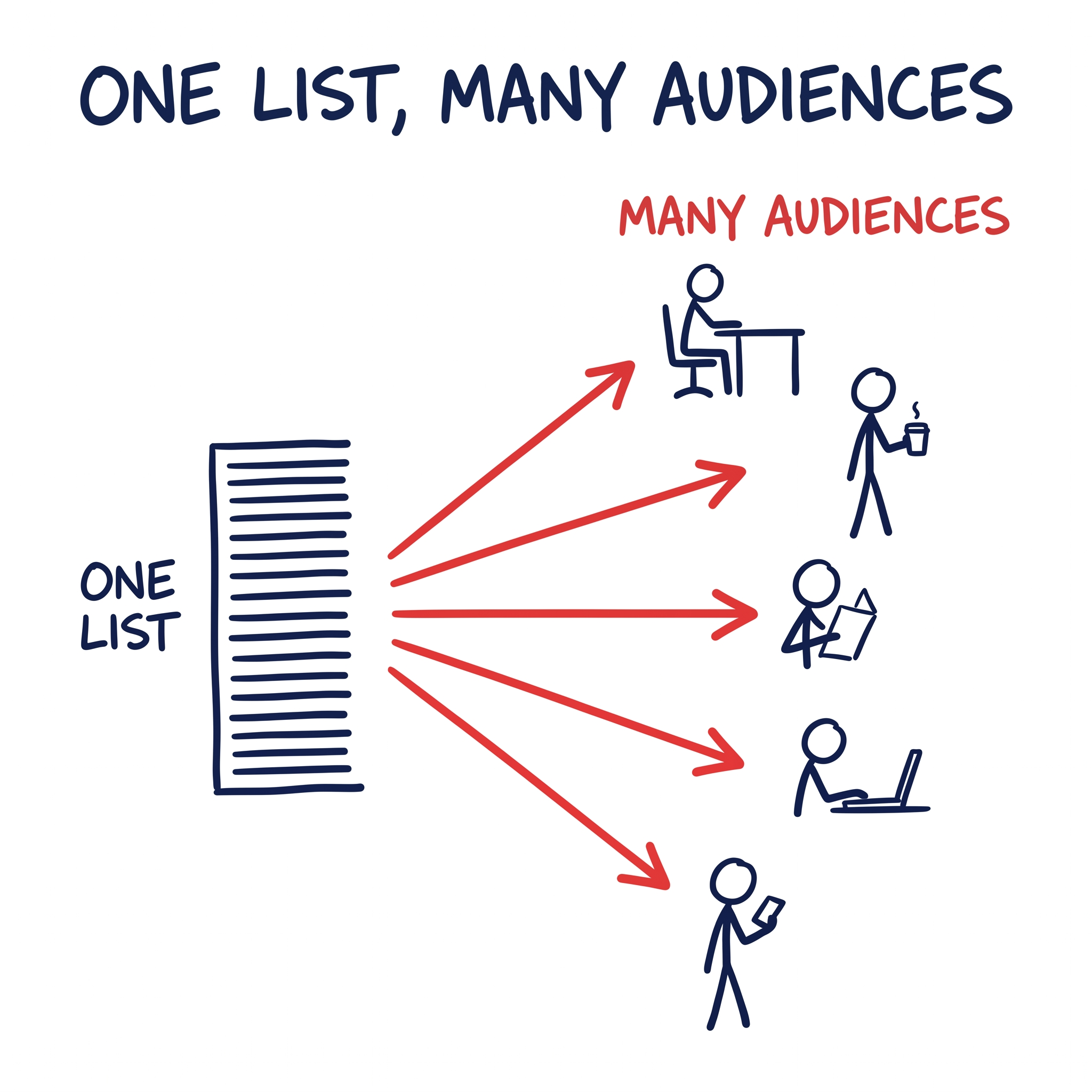
We had just launched our fourth newsletter for wealth management professionals, and I was asked whether the results were good. We had 1000s of readers, tick. It was increasing edition on edition, tick. But what excited me most was the overlap between the titles was low. The people reading one were mostly not the people reading another. The investment in multiple newsletters allowed us to engage with many different audiences.
Most organisations don’t spend enough time to treat their database as having more than one or a handful of segments. Most see it as a single precious list, built over years, to be handled with care and mailed as little as possible. Send too often and you burn goodwill, drive people to unsubscribe, and train the remainder of the database to ignore you. So the advice in most B2B teams is to hold back, batch the sends, pick the few moments that matter, and protect the list by staying quiet.
I understand the instinct. Nobody wants to be the person that increases unsubscribes. But that instinct is based on several assumptions that are questionable.
The first assumption is that a database is one audience, when it is really a whole lot of different people who happen to share a field in a database. A financial adviser and a back-office administrator do different jobs and need different things. A business owner and office worker sit at different points in their careers. Treating them as a single list means writing for an average reader who does not exist, then wondering why the open rates are soft.
The second assumption is that frequency is what causes fatigue, when the real cause is irrelevance. When an email arrives that a reader values, that respects their time and tells them something useful, they welcome it whether it comes monthly or every morning. When it says nothing they need, once a quarter is already too often.
Email fatigue is not a volume problem. It is a relevance problem.
Get that the wrong way round and you spend your energy cutting sends while the actual cause carries on untouched.
Email, the original social media
Long before anyone had a social feed, a newsletter was a direct line to people who chose to hear from you, on a channel you owned rather than rented from a platform that can change the rules on a Monday. The odd thing about now is that most companies run their social presence with more discipline than the email database they actually own.
When I started at Netwealth we had one newsletter, it was sent monthly. When I left, we had 6 and in people’s inbox weekly.
We had grown the marketing opt-in database from 7,500 contacts to more than 45,000, a 600% increase. But the number that mattered was not the size of the list, it was what we did with it. We had built a family of six newsletters reaching more than half of the database, around 30,000 readers, across distinct segments, and each one was a different publication designed for a different reader. All with different cadence, a different length, its own editorial voice, doing a different job.
- Morning Business Roundup was a daily business and economic update, and had a weekly readership of over 10,000, the kind of thing you read with a coffee before the day starts.
- IQ Lens was a monthly roundup of the important tech news that mattered, and had over 7,500 readers a month.
- IQ Trends focused on leadership hacks, was a long-form highly researched newsletter, which had 11,000+ readers per edition. Topics included: NPS, Sleep, Growth Mindset, and Wearables.
- IQ Bites, a bi-monthly short and sharp newsletter which drew on the insights from the annual proprietary research programs, again read by over 8,000 people monthly.
- Best Practices, another bi-monthly newsletter that spoke to users of the software about getting more from it. Over 12,000 readers per edition.
So trying to build newsletters with low overlap was the point. The aim was breadth across the database rather than depth with one engaged core.
We were running a media company model inside a B2B marketing function, and a media company does not publish one newsletter for everyone, it publishes different titles for different audiences.
The daily taught me the frequency lesson quickly. A weekday email arriving at the same time every morning stops being an interruption and becomes a habit. People expect it. Some tell you when it is late. You cannot build that with an irregular send you hold back out of caution. You build it by matching the frequency to the format, a daily that earns three minutes, a bi-monthly that goes deeper, a monthly that does the heavy research, and then showing up on that rhythm without fail.
If a competitor could rebuild your newsletter in a week, it was never a moat.
What world-class looks like
You do not have to invent this from nothing. A handful of newsletters make both rules look easy, and they are worth studying. These are the ones I read:
- Lenny's Newsletter (Lenny Rachitsky): original product and growth frameworks, wrapped around a 30,000-person community you could never copy.
- CB Insights (Anand Sanwal): proprietary data in a famously funny, fully self-contained format, the sharpest example of both rules at once.
- Total Annarchy (Ann Handley): B2B marketing's craft benchmark, a complete essay you read in the inbox and never a teaser.
- FS Brain Food (Shane Parrish, Farnam Street): a weekly collection of timeless ideas and mental models, original curation with a distinct lens.
- Superhuman (Zain Kahn): a fast, practical brief on using AI at work, short and useful and finished in the inbox.
- TheFutureParty: where business, culture and entertainment meet, a punchy daily you get through without leaving.
- Forum Stories (World Economic Forum): global issues told through the Forum's own research and convening power.
- Strategy and Business (PwC): management thinking backed by a firm's own research, the owned-authority play at scale.
- McKinsey Quarterly (McKinsey): the reference point for firm-owned research as thought leadership.
- Benedict's Newsletter (Benedict Evans): a weekly read on technology and its consequences, original synthesis you cannot get anywhere else.
- Morning Brew (Alex Lieberman and Austin Rief): a self-contained daily brief you never have to click out of, built into a media business.
If you apply one thing from this 🛠️
The work is not sending less, it is knowing who is on your list and giving each of them something worth the space in their inbox.
- Audit the database by role, seniority, relationship stage and product usage. The segments are already sitting there, waiting to be written for.
- Design distinct publications for distinct readers, each with its own frequency, format, voice and purpose, rather than one newsletter aimed at an average that does not exist.
- Build unique content, not the average. Look for gaps in their media consumption diet and fill it. Where possible make sure it aligns with your brand strategy.
- Treat low overlap between titles as evidence the segmentation is working, and something to leave alone. Cross-promote strategically to introduce a reader of one title to another that fits them.
- Before you cut frequency, audit relevance. Steady opens with weak clicks means people open from habit but find nothing useful, which is a content problem, and cutting the frequency will not touch it.
- Match frequency to format and then hold the cadence, so a reader comes to expect you. Irregular sending is what destroys the habit, not frequent sending.
- Purge your lists regularly. Monitor open rates over time, and when people stop opening several of your newsletters it is time to ask them whether they want to receive them any longer. Purge those you don’t hear from immediately.
The fair objection
Over-mailing does drive unsubscribes and damage deliverability, and anyone who has watched a sender reputation slide knows the risk is real. Send junk often enough and the inbox providers start filing you under spam before a human ever gets the chance to decide.
True. But look at what is actually driving people out. They rarely leave because a useful email came too often; they leave because an email they did not want came at all.
I still think about that overlap chart, five audiences, each getting something built for them, on a rhythm they had come to expect – an email in their inbox that was relevant.