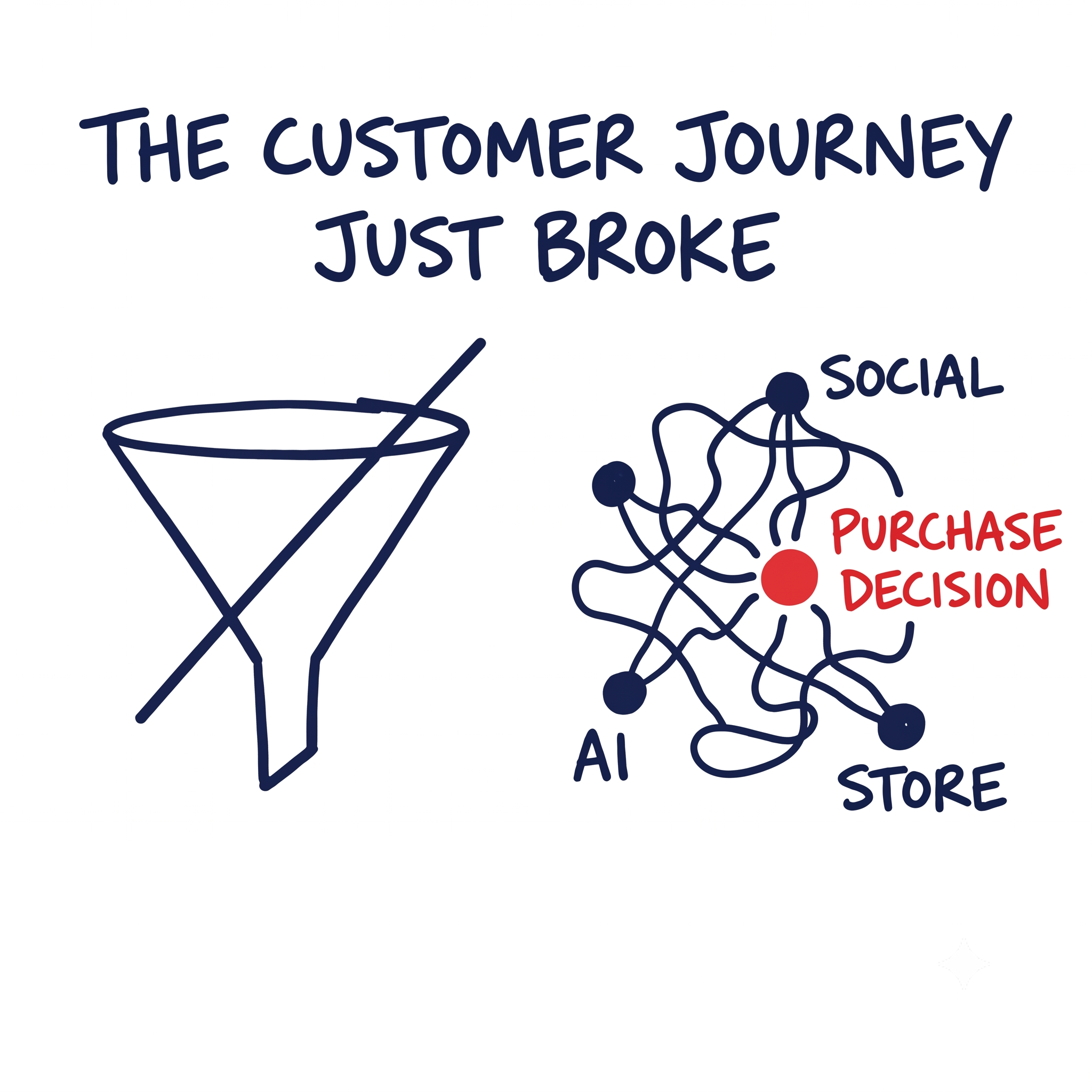
Lately I've caught myself doing something different. When I'm looking for something, holiday accommodation, a new pair of sneakers, an appliance for the house, a battery pack for my phone, I no longer scroll through the search results or go straight to Amazon. Instead, I click the AI mode in the corner of Google and just read. The reason is simple. The AI mode answers me in plain language, gives me the pros and cons, and lays out the features in a way I can actually take in. Deciphering the list of blue links and reading through tens of websites has started to feel like work I no longer need to do.
I observe my kids, who are ten and thirteen, Gen Alpha, a generation who have grown up with an internet device in their hands. I've tried to understand where they get their ideas for a new toy, a hairstyle, a song worth listening to. Not from a search box, and never from a website. It comes almost entirely from social, from what their friends send each other, what an influencer said, what everyone online is talking about, that then spills onto the footy field at lunchtime or when they are standing around chatting with their mates.
Now, I am an early adopter, so me using AI for everything is only a lead indicator - two data points from one family is a story, not a trend. So I went and checked whether this is actually happening in the wider world. I read the research, some of it, fittingly, with the very AI tools this article is about, and the evidence was clear enough that I thought I would share.
AI and social media lead the way, but the store is not dead
McKinsey's State of the Consumer 2026 describes exactly this: a path to purchase that has broken apart across AI, social, video and the retail store, all at once. 22% of respondents have used AI for shopping and for managing health and wellness in the last 3 months, 19% have used AI for getting financial advice, and 18% for planning trips and occasions.
Social media’s role in the consumer decision journey is also important to understand. For older baby boomers, 16% use social media sites for purchase evaluation. For younger Gen Z (14-29 years), social is now the most important digital channel of all, with 34% saying it shapes the actual purchase decision.
And yet the retail store still leads as the most common source for new brand discovery for both Boomers (52%) and Gen Z (28%). The shop is not dead.
How important is your own website?
The most striking number is about your own website. According to McKinsey, when an AI answers a question about a brand, just 1 to 2 percent of the sources it draws on come from that brand's own website. It draws from social media, ratings and review websites, articles and other sources as well.
And this is not one consultancy's outlier. Google's own head of search admitted a few years ago that nearly 40 percent of young people, when they want somewhere to eat, skip Google entirely and look on TikTok or Instagram instead. Adobe, watching actual retail traffic rather than asking people, found visits to US shopping sites from AI tools jumped more than 1,200 percent in a single year, and that those AI-referred shoppers convert better than almost any other source. Three different vantage points, a survey, the search engine itself, and the checkout data, all pointing the same way. (1) (2) (3) (4)
Usage is up, but trust is down
Here is the part the AI headlines miss. The younger the customer, the more they use AI and social for product research, yet trust them less than other sources. YouTube being the outlier here where the content is longer and more substantial, holds far more trust than a quick scroll. Faith in influencers has fallen. And it is Gen Z, the very generation using these channels the most, who trust them the least, more sceptical of both AI and social than the boomers are.
Offline channels, such as friends/family, professional recommendations and sales assistance are the most trusted.
"The path to purchase is no longer a straight line. It is a web, and your customer trusts it less than they used to."
If you do one thing
So the job isn't to pick the channel that wins. It's to rethink how people find you, and come to trust you, well before they ever get in touch, across all of this at once. Four things I'd focus on.
1/ Treat discovery as the main eventMost of us spend our time and our budget on the last step: the landing page, the follow-up, the sale. That's the part we can measure, so that's the part we polish. But by the time someone reaches your website, calls you, or walks into the shop, the decision is mostly made. It got made earlier, in a dozen places you weren't watching. If you only pay attention to the last step, you are polishing the part of the journey your customer has already finished.
2/ Make your business the answer, not just a linkWhen an AI writes the summary, you're not fighting to be the link someone clicks anymore. You're trying to be the thing it quotes. In practice that means being clear and specific about what you do, proving you actually know your stuff, putting up the FAQs, getting onto the ratings and review sites, showing up on social, and saying the same thing consistently everywhere. Do that for long enough and the machine learns to repeat you.
3/ Show up where trust still livesAs everything fills up with AI-generated filler, the places that still feel trustworthy are worth more, not less. A proper piece of writing beats a throwaway post. A real video review beats a slick ad. A human moment, in a store or at an event, beats another impression nobody asked for. And your name, on something you actually know, beats anonymous content every time. The more the average stuff gets churned out by a machine, the more a real voice stands out. That part is yours to earn.
4/ Win on trust, because using something isn't the same as trusting itIn the end the scarce thing is belief, and it comes from showing up as the same business, saying the same true things, again and again, wherever people run into you. The strongest version of that is an audience you actually own: an email list, a community, something that's yours. Everything else, you're renting from an algorithm that can change the rules overnight.
The fair objection
The fair objection is that this sounds like be everywhere, which is a recipe for exhaustion, not strategy. Be on AI and social and video and in-store and email, and end up doing all of it badly. Fair, and it is the opposite of what I mean. Because trust is scarce, you do not win by being thinly spread across everything. You win by being credible in the two or three places your particular customer actually decides and actually believes. The discipline is choosing those few, and being unmistakable there.
"Attention is cheap now. Belief is the scarce resource, and no channel hands it to you."
When I click that AI answer, or when my kids decide a toy is the one because three of their friends already have it, the same thing is happening. The decision is being made away from any channel a business controls, by something the customer already trusts. The brands that win those moments are not the ones shouting loudest in any single place. They are the ones credible enough to be named when the customer is not even on their turf.
---
The path to purchase has broken into a hundred pieces. The work now is not to be in all of them. It is to be trusted in the few that count.
---