I was lucky enough to get an Apple IIe when I was nine. I was consulting to businesses about websites well before they even knew what a website was. I joined Facebook 10 days after it was launched. I created and built mobile apps before there was even a 3G network. I have seen the rise of web 2.0, cloud computing and now AI. I have built websites, email systems, CMS, banking & accounting software, portals, and intranets.
The reason I share this is not to show off, but to illustrate that I have witnessed several waves of technology in my life and observed their cultural and business impact.
When it comes to business tech, the shiny new toy syndrome is real
A team buys the tool everyone is talking about, marketing automation, an AI assistant, a new HR system, a customer data platform, with the hope that this one will finally sort things out. Six months later they have an impressive new capability. The tool did everything it promised, but often nothing has changed.
Tech companies are wonderful marketers, selling each new technology as the answer to the last one's disappointment, and the pitch is always a version of the same promise: adopt this, and the hard part gets easier. "We should be using AI" becomes a strategy in itself, a line in a board pack, a budget request. The enthusiasm is understandable, the tools are powerful, and standing still while competitors adopt them is a real risk.
But somewhere in the rush, the real question hasn’t been asked: “What opportunity are we trying to solve for?”
So when is a new technology a multiplier?
The answer: point the technology at a clear commercial strategy and the returns compound. Point it at a vague one and you get the same vagueness that no technology can fix.
"A tool does more of whatever you point it at. Point it at a vague strategy and you get faster noise."
Garry Kasparov learned this the hard way and then made it useful. After IBM's Deep Blue beat him in 1997, the easy conclusion was that the machine had won and the human was finished. Kasparov drew a different one. He invented "advanced chess," where a person plays alongside a computer, and the real lesson of the match emerged: an average human with a machine and a good process could beat both a grandmaster alone and a supercomputer alone. The machine supplied the calculation. The human supplied the judgement about which calculation mattered. Neither was enough on its own.
Technology accelerates the right strategy. It can't substitute for one.
I have now been on both sides of this across two decades, the buyer evaluating tools, and the seller promoting the latest technology. The lesson holds from both seats.
AI accelerates execution: drafting, analysis, personalisation, compliance review, workflow automation. But the quality of what it produces is set by the quality of the thinking that directs it, the ‘human in the loop’.
For marketers, a clear brief, a defined audience, a sharp position, these decide the output. Poor upfront strategic thinking executed quickly with AI is still poor strategic thinking, now with better grammar and formatting.
So before you evaluate any technology, name the specific commercial problem it is meant to solve. Not "we should be using AI," but "our compliance review takes two weeks and delays every launch, and AI-assisted review could make it three days."
Judge success by adoption and outcomes, not implementation
On the topic of sales and marketing technology (revtech), I have seen many stacks grow by default, rather than design.
Scott Brinker's annual map of the marketing-technology landscape has gone from about 150 tools in 2011 to more than 14,000 today. And on average, companies actively use just 33 percent of the martech capability they already pay for, down from 58 percent in 2020.
Most stacks are not under-tooled, they are under-used, and the gap is widening. It is important to judge the tool against the business opportunity, not its feature list, and measure adoption, not implementation. For example, a CRM the sales team uses inconsistently produces inconsistent data, which produces unreliable insight, which kills adoption further.
So the question before buying anything is not which tool is best. It is: what behaviour is this supposed to change, and why isn't it changing now? This is often a human behavioural issue, not a technology issue. Change for many of us is hard, especially in a fast-paced environment that doesn’t allow time for learning new things.
This is where most rollouts fail, and it is a change-management job, not an IT one. Five things that actually move the needle:
1. Sell it inside like a product. Before you roll it out, make the case to each team the way you would to a customer: what is in it for them, what it takes off their plate, and why now. People adopt what they have been educated on, not what they have been handed.
2. Train little and often, not once. A single launch-day session is forgotten by Friday. Short, regular, in-the-flow training and refreshers make using the tool the right way the path of least resistance.
3. Back the champions. Find the two or three people in each team who love it, give them a bit of time and status, and let their enthusiasm pull the rest along. Peer adoption beats a top-down mandate every time.
4. Make it a bit of a game. Visible wins, a simple leaderboard, a nod to the early adopters, a small reward for the first real result. A little friendly competition turns a chore into something people opt into.
5. Measure adoption, then kill the friction. Track whether people actually use it, and use it well, not whether it got installed. Where they do not, ask why, fix the awkward step, and go again. Adoption is earned, then maintained.
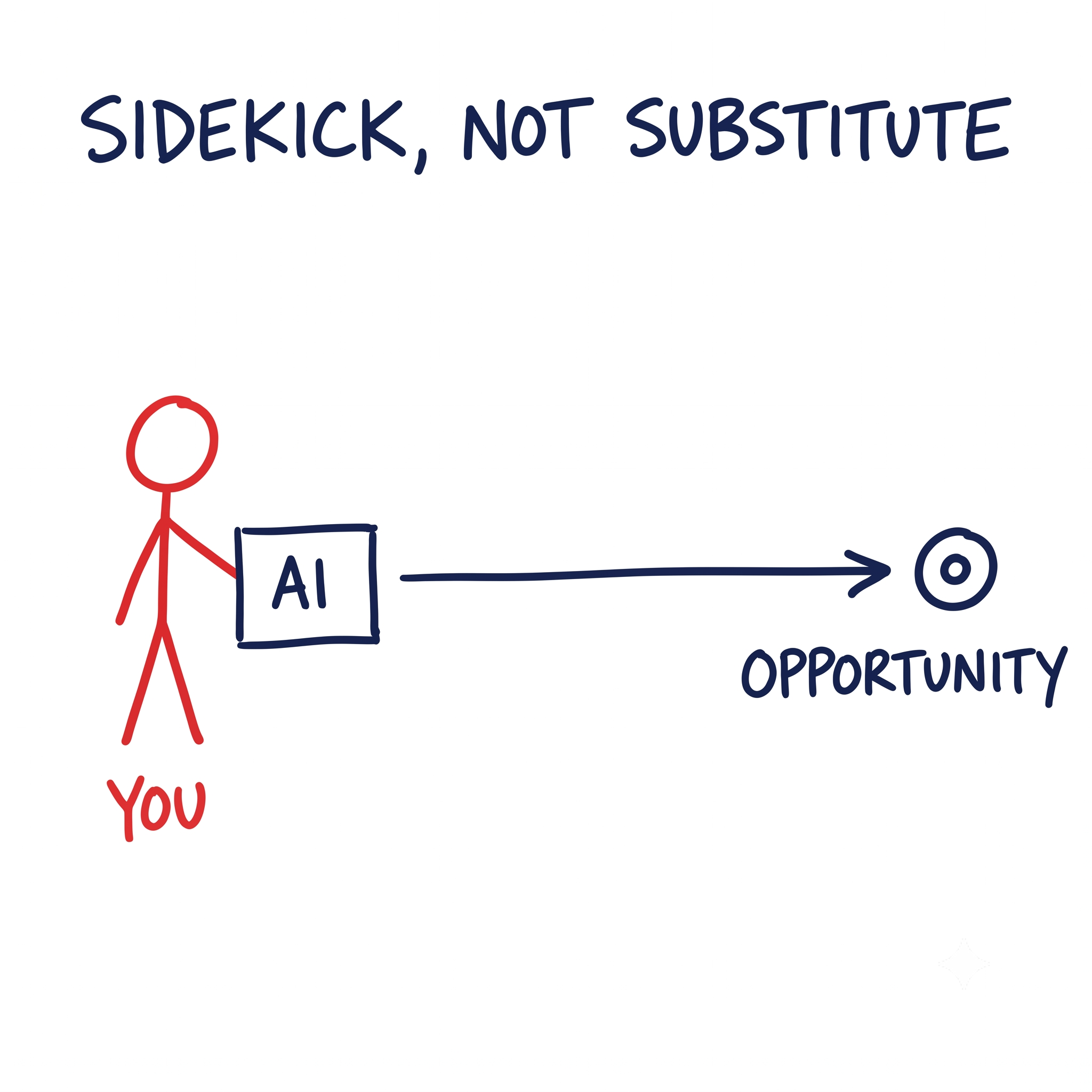
AI is a growth sidekick, not a substitute.
Marketing and sales have a shiny new toy in AI.
AI amplifies your thinking, it doesn't generate it. You're the start, and the final call. The bit in between is where it helps.
AI earns its place in first-draft generation, research synthesis, compliance pre-screening, personalisation at scale, and account-level outreach. It is not where you decide which market to own, which customers to prioritise, or how to differentiate. It does not originate the idea that surprises people, hold the board conversation, or carry the ethical judgement in a regulated industry where a wrong answer has real consequences. It lacks wisdom, craft and often creativity.
That said, AI executes faster. And with a human-in-the-loop, as Garry Kasparov found out decades ago, it can execute better.
I built my own AI marketing system on exactly this line: the machine produces far more than a person can read, so the whole design keeps a human in the loop at every decision, amplified by the AI, never replaced by it.
Technology superpowers human ingenuity. The real question is not whether to adopt the tool, it is whether you know what you would point it at once you had it.
The team with the shiny new technology was never going to find their direction inside it. The tool could do a great many things, but prioritising which of them mattered was the one thing it could not do for them. That part was always human.