Many years ago I killed a content idea that everyone in the room liked. It was a monthly newsletter series on running a better investment operation, practical, well-researched, the kind of thing our audience of financial advice firms may have read and shared.
The angle wasn't weak, but we were repositioning the business as a fintech, trying to be known as the technology leader in wealth management, and a general investment-management series, however useful, was not pointy enough. It would have taught advisers how to run their investment operation better and aligned them our offer to just investment, not technology.
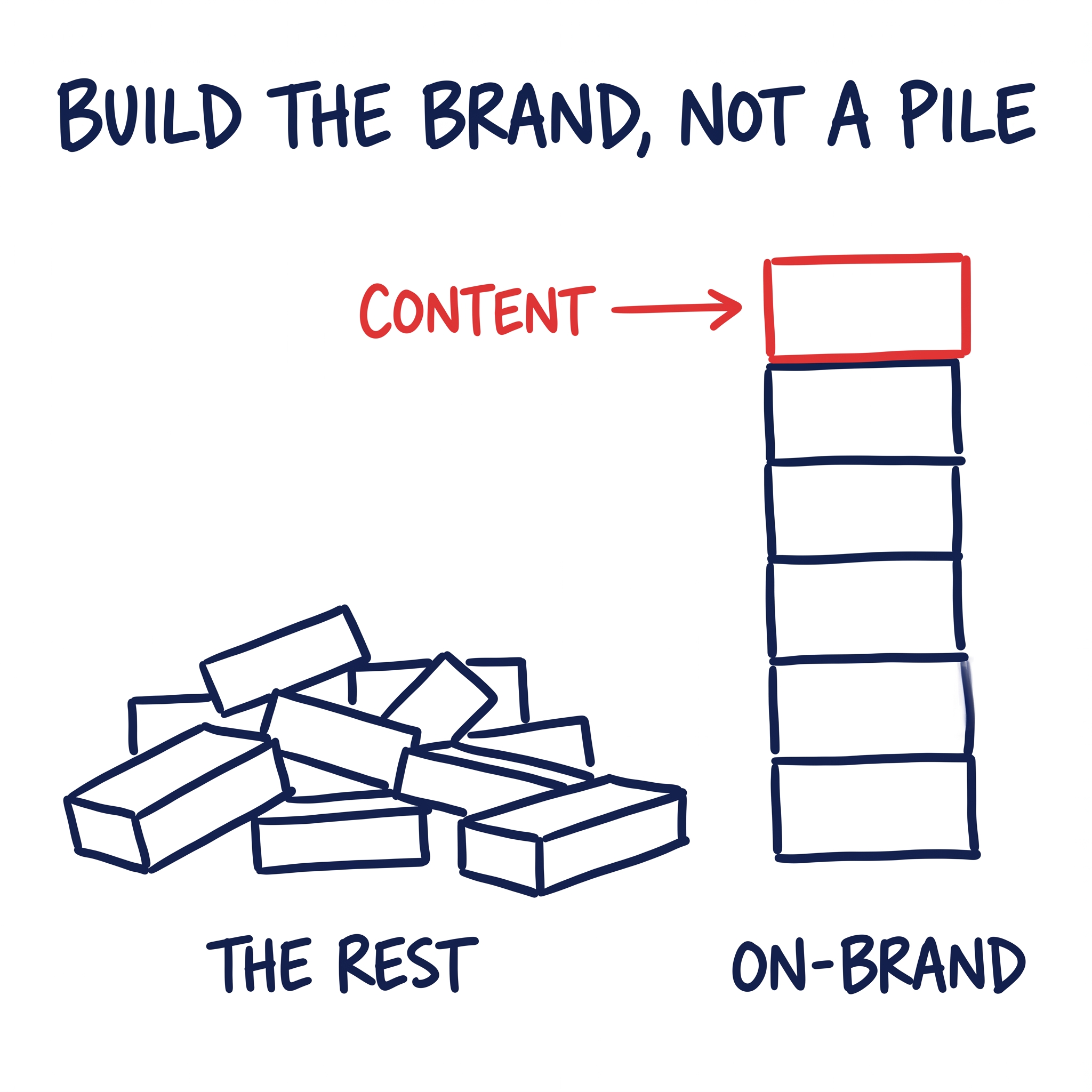
Most content marketing is run as a utility function. Be helpful, publish what people find useful, answer the questions your audience is typing into a search box, and the more of those you answer the better. And it should. Useful content does build an audience, and an audience is worth having. The problem is that usefulness is only the starting point. A piece can be helpful and still do nothing for the brand. Worse, it can pull the brand somewhere it never meant to go.
It is important for the marketer to challenge themselves. Are you a team that stands for ‘we publish things’ or rather do you own a specific, ownable idea linked to your brand.
Random acts of useful content are still random.
It is important to remember a brand is the sum of what people can reliably associate you with. If half your content output points at “technology leader” and the other half points at “investment management,” the association blurs, and a blurred association is worth very little in the moment someone is deciding who to put on a shortlist.
The clearest example I have is a word
Eight years ago “AdviceTech” was not a term anyone in Australian financial advice used. We built it, through a research programme that surveyed more than 300 advice firms a year, published as an annual report that drew 1,500-plus downloads an edition, and carried through national roadshows, webinars, and a buyers guide that catalogued the technology categories on the market, competitors included.
None of that was general-interest content. Every edition did one specific piece of brand work: it positioned Netwealth as the authority on technology in advice, the exact territory the brand had set out to own under “See wealth differently.” Eight years on, “AdviceTech” is the standard term. Advisers use it, platforms use it, regulators and trade media use it. Competitors now describe their own products with our word.
That is about as durable as positioning gets, because when a category adopts your language you become the reference point every time the subject comes up. HubSpot did the same thing with “inbound marketing,” a term its co-founder Brian Halligan coined and the company deliberately gave away. As his fellow co-founder Dharmesh Shah put it, they wanted everyone else to use the term precisely because they intended to be the company most known for it.
Now put the investment-management series back next to that. Useful, yes. But it would have spent the same budget and the same year building authority in a category that was relevant, but didn’t enhance our brand.
The podcast we built for our CEO did different brand work again, more than 100 episodes of real conversations with industry leaders, 750 to 1,000 listeners an episode, positioning him as the connected voice of the sector. It was a classic ‘Founder as a Brand’ execution. We also ensured that he spoke regularly at industry events, and spoke in the media.
The Advisable Australian consumer study, more than 1,000 Australians surveyed every year, also did a brand job. Netwealth’s brand position at the time was ‘see wealth differently.’ By investigating and demonstrating an understanding of wealth from the end-investor's angle, we were able to share with financial advisers insights about their clients that they were not seeing. And not surprisingly, the insights were often about their attitudes to technology.
If you apply one thing from this 🛠
Before you brief another piece of content, run it through the test the AdviceTech program passed, and the investment series failed.
→ Start with the brand position, not the topic. Name the territory you are trying to own and the two or three attributes you must be associated with, before anyone pitches a single idea.
→ Map every initiative to one attribute. If you can't say which specific thing about your brand a piece reinforces, that is your answer, not a gap to fill in later.
→ Audit what you already publish. Sort your existing content into three piles: reinforces the brand position, contradicts it, or stays neutral. The third pile is usually the biggest. Don’t necessarily kill it, but perhaps re-emphasis resources.
→ Reject useful-but-off-brand ideas. A well-produced series in a category you don't want to own is still off-strategy. Kill it, however good it is.
→ Make the brand connection explicit for sales. When your team uses a piece of research in a commercial conversation, they should be able to say in one sentence what it proves about you, not just what it teaches the client.
The fair objection
A commercially sharp person would push back here. Useful content builds trust and search visibility whether or not it's on-brand, and trust and traffic are valuable in their own right. Isn't any audience-building good audience-building?
Up to a point. Reach is real, and I would never argue against being useful. But reach without positioning builds an audience that associates you with the topic, not with your brand. You can become the place people go for good general business advice and still lose the deal to a competitor who owns the one category that actually decides the purchase.
The series I killed would have been good, that was never the question, it may have even outperformed the AdviceTech research that built a category. But that wasn’t the point of the content.
The question I asked, and the one worth asking before you approve anything, was simpler than any metric: if this content does its job perfectly, what will we be known for? What will be known for?