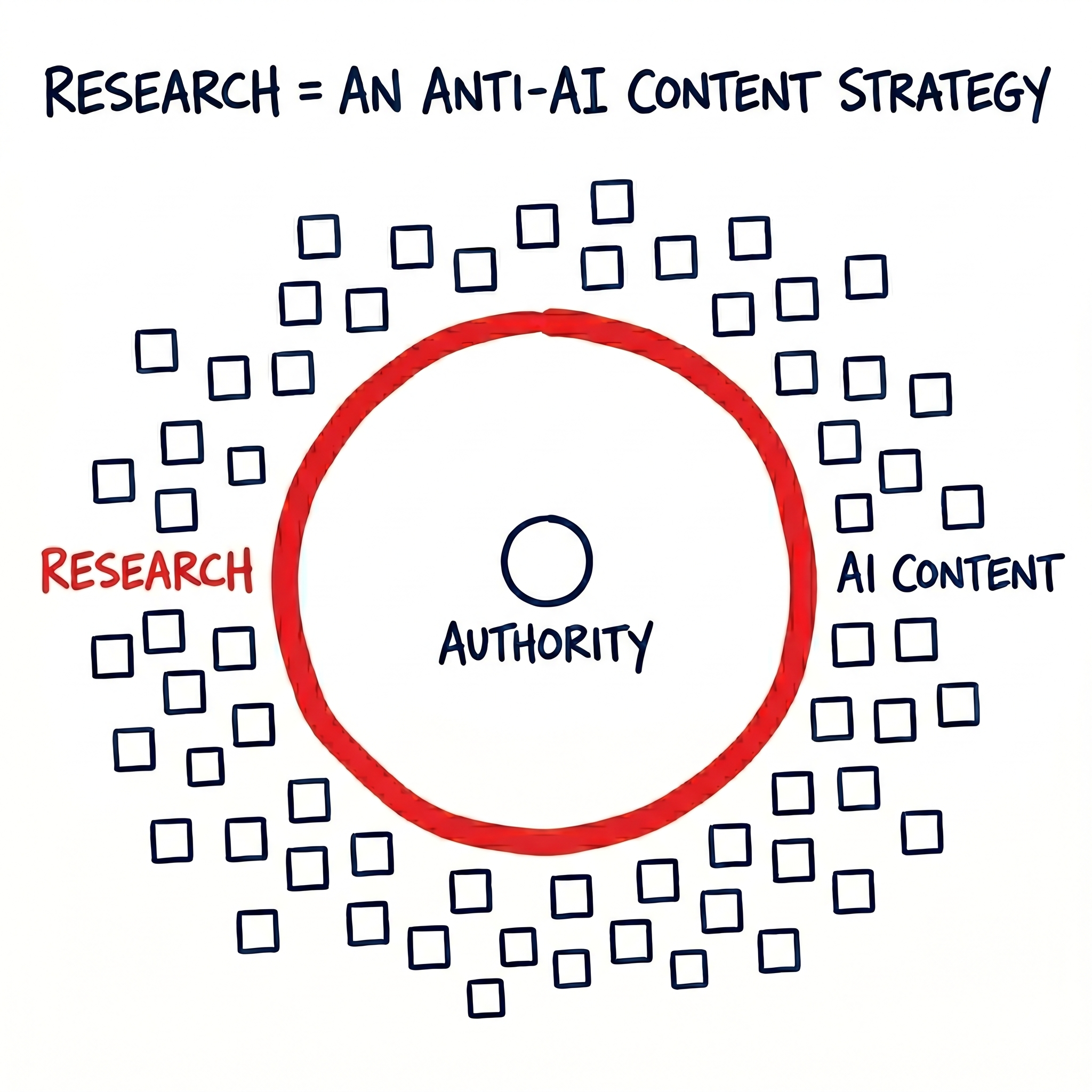
A marketing team I spoke with recently had ten times the output it had two years ago. Ten times the blog posts, three times the campaigns, a content calendar that finally looked full. AI had done exactly what every CMO was promised it would do, and the team was thrilled with it.
Then someone asked about pipeline and revenue.
The leads, the cost per lead, the conversion rate, and brand metrics had not moved at all. The team had become very good at producing content, but no better at producing business results.
The gift AI hands marketing teams is volume, where everyone has the superpower of more, so that is what many are using it for.
In fact, some research suggests this is now most of the internet, with 74.2% of newly created web pages having AI-generated content (across an analysis of 900,000 pages by Ahrefs, April 2025).
More posts, more campaigns, more variants of the same email. This feels like progress because the output line goes up and to the right, but is it?
What AI can't copy
With the over-production of content, cutting through the ‘moreness’ is the challenge most marketers face today. To do this, smart marketing teams are asking whether any of it connects to something the customer actually needs, whether it provides them utility, and whether it is unique (and human).
When everyone can produce unlimited content at close to zero cost, content stops being an advantage. An advantage is something a competitor cannot easily copy, and AI-written content is, by definition, the most copyable thing in the world. Anyone with the same prompt gets the same (or similar) paragraph.
So the useful question is not how to make more, but what you can publish that no one else can.
That answer is rarely another opinion piece (because let’s face it, how many of us have an original opinion). It is proprietary data: research a competitor cannot easily replicate because it takes time to do the work, get the sample, ask the questions, and analyse the responses.
The one thing a competitor can’t easily copy is the data you went out and gathered yourself, and then analysed and interpreted.
Why research compounds when content doesn't
At Netwealth we ran an annual research program for eight years, surveying more than 300 financial advice firms about the technology they used or intended to use, the AdviceTech report. Competitors could outspend us on events and advertising, but it was much harder for them to get 300 advice firms to tell them the truth about the tools they used. After 8 years, it became impossible to replicate the research because of the longitudinal data that was collected. The research and insights became an industry standard.
This is not a one-company quirk. A 2025 TopRank and Ascend2 survey of B2B leaders found that marketers publishing original research reported 64% higher conversion rates than those relying on aggregated content, and a third rated original research significantly more valuable than AI-generated content for building trust. The market is already pricing the gap between content anyone could have written and that only you can.
And this is not a wealth-management trick, or even a technology one. Michelin, a tyre manufacturer, started rating restaurants in the 1920s to get people driving further, and a century later its anonymous Michelin Guide inspectors still decide what fine dining means. Edelman, a PR firm, runs its Trust Barometer every year, surveying around 34,000 people across 28 markets and showcasing it at Davos, so that anyone arguing about trust in institutions ends up arguing with Edelman’s data. Knight Frank’s Wealth Report, now in its twentieth edition, tracks prime property and the ultra-wealthy and has become the reference their consultants reach for first. PwC surveys thousands of CEOs each January and owns the headline on what the people running the world economy are afraid of. Spotify surveys no one: it turns its own listening data into Spotify Wrapped, and every December its users advertise it for free.
Different industries, one move: produce data only you could have produced, on a question your customers care about. Unique and relevant is the key test.
The nature of research is that it compounds because it is built as a program, not from a response, or a campaign. When running annually, you can add richness with a different deep-dive angle each year to keep it from going stale. Including a benchmark, something customers can measure themselves against, gives them a reason to come back and compare. The tenth edition costs roughly what the first one did, but by then you have an audience that treats you as the source.
Importantly, one study is never one asset. The same body of work becomes a white paper, a keynote, a buyer’s guide, a dozen articles, a video series, podcast interviews and a year of newsletter editions. The research data is the raw material; breaking it into pieces is how it travels.
If you apply one thing from this
If you decide to build a research content program, build it to last and build it to travel:
- Pick a knowledge gap that matters to your customers, not one that flatters your product.
- Make it unique and relevant, not just big: a dozen sharp interviews with the right people can beat a survey of thousands.
- Choose a different deep-dive angle each year so the program never repeats itself.
- Build a benchmark or framework customers can score themselves against.
- Survey the people around your customer too: their suppliers, partners, and clients.
- Break every edition into pieces: a white paper, a keynote, a buyer’s guide, articles, and video.
- Commit to it annually. One-off research does not build authority; consistency does.
- Align the research to your brand positioning, so that they work in harmony.
- Train sales deeply on the findings. Have them present it, not just receive it.
The fair objection
A reasonable person pushes back here: we are not Netwealth, we do not have eight years or a research budget, and our competitors are already publishing daily. Fair.
But you do not need eight years or a cast of thousands to start. A dozen honest interviews with the right people can be more original than a survey of one thousand, as long as you ask the questions no one else thought to ask. The first edition will not be a moat. The fifth will. The barrier to making this happen is rarely budget, rather it is the patience to commit to something when a faster content win can be quickly generated.
AI did not lower the value of good content. It collapsed the value of average content to zero, because average is now free and identical, available to your competitor from the same prompt you used.
What survives is the thing the machine cannot manufacture: the question you asked, the people you surveyed, the data only you can hold. Everyone else is busy filling the internet with writing that sounds like everyone else’s writing.
Dig the moat.