A first-year design student with a Canva login can now produce a logo that would have taken a studio a week in 1995. A teenager, phone in hand, shoots footage a film crew once needed a van of equipment for. And anyone with a chatbot can generate a competent article, a passable ad and a serviceable business plan before lunch. The making of things has collapsed in cost, across almost every creative craft at once.
The thing that has not collapsed, and has in fact become more valuable, is the judgment to tell the good from the finished.
We have been here before, just never this fast or this broadly. When cheap cameras and then phones put a decent lens in every pocket, taking a photo stopped being a skill and seeing a shot worth taking became the whole game. When home software turned any bedroom into a recording studio, making a track got easy and knowing which track was worth releasing got hard.
The bottleneck moved from making to judging
For a century the hard part of creative work was making the thing: writing the words, shooting the photo, cutting the film, laying out the page. Making was slow and expensive, so making was where the money and the status sat. AI has taken the cost of making and pushed it close to zero. When everyone can produce a competent version of anything in minutes, competent stops being worth anything.
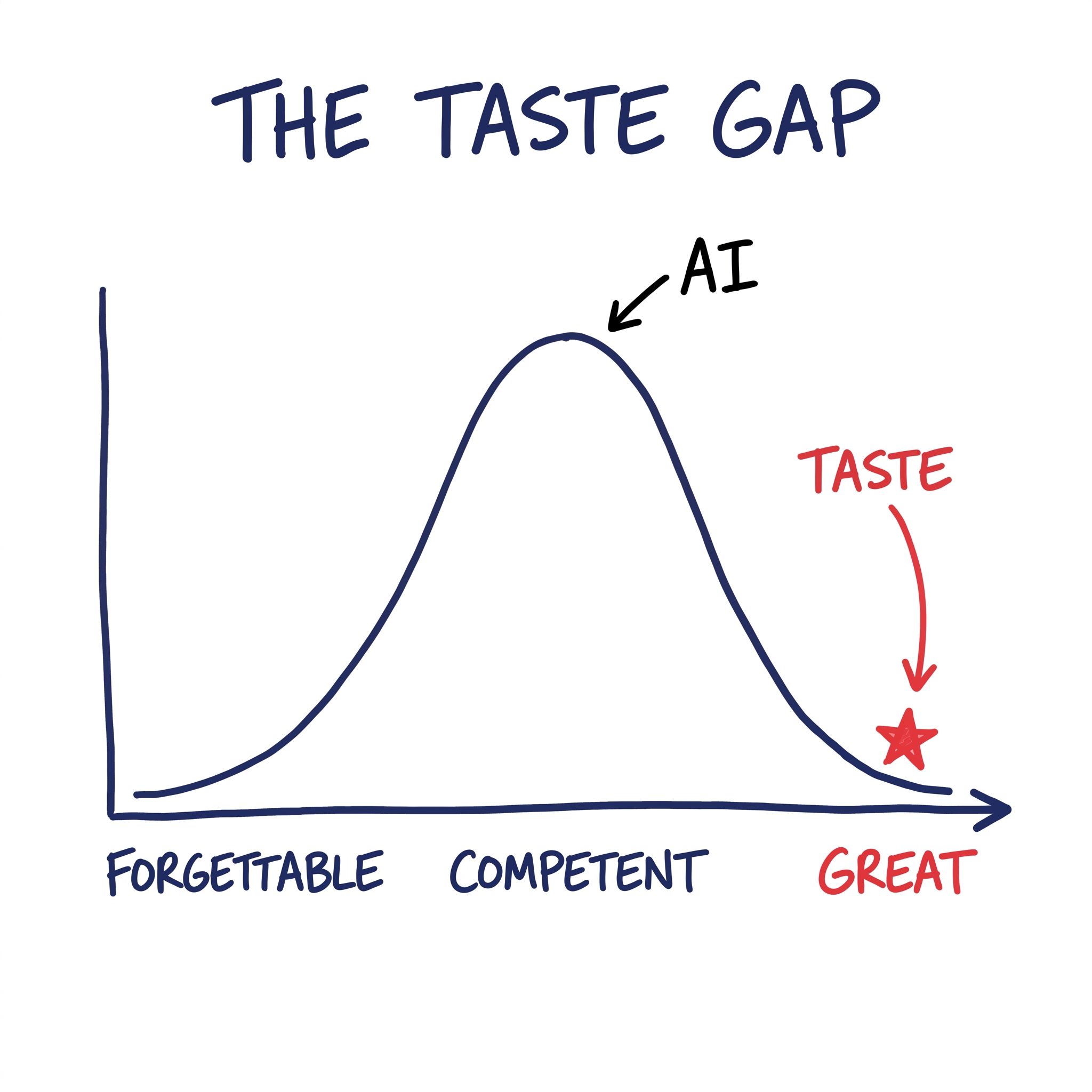
An AI model is built to predict the most probable next word, so it reliably lands near the average of everything it has read. That makes it fast, useful, and by definition unremarkable.
What becomes scarce is the judgment to tell the good from the plausible.
My own experience has taught me this faster than I expected. I built a marketing studio that runs on AI agents: a Creative Director that develops the ideas, a Producer that writes the copy and makes the images, a Brand guardian and a compliance checker that review every asset, and a researcher that digs up the evidence. It can take a raw idea and turn it into a newsletter, the posts to promote it and the artwork to carry it, in an afternoon.
Related reading: How I built an AI creative director with taste →
The human at the centre has a new role, to orchestrate the input, and decide whether the output is good.
Without the human in the loop, the machine will happily produce something plausible every single time: confident, on brief, sometimes creative, and often subtly wrong. An image that is almost right. Arguments shaped like an insight, with no insight inside.
Why taste is the job now
Taste is the ability to hold a standard, notice the small wrongness most people miss, and say no to work that is largely ok. Taste has always mattered but it used to be hidden inside the creation, so we never really recognised it, assuming the two were the same thing. Now that creation is automated, taste stands on its own as the job to be done.
The easy fear is that AI floods the world with content and drowns everyone equally. In practice the opposite is closer to the truth. When the average gets cheap and plentiful, the average becomes invisible, and anything with a real point of view stands out against it.
The scarcity is no longer production. It is a voice worth listening to.
This is why the brands that win the AI era will not be the ones generating the highest volume. They will be the ones with the clearest taste, applied so relentlessly that every machine-made thing still carries a human standard. The moment a customer can sense the AI, you have either used it lazily or you are missing the taste to finish it properly.
Why creativity becomes the cornerstone of education
If this is true for marketing it is true for learning. We built an education system to teach people to make things: to write the essay, solve the sum, draw the diagram, produce the output. Much of that making is now the part a machine does best. Teaching only the mechanics is training people to compete with the tool on the tool's own ground.
Are we teaching our kids not only to create, but to judge whether an argument is reasonable, an insight holds, to tell if something is designed with flair or just a good copy? The durable skill will be one of taste and judgement.
The generation that can direct and judge will run circles around the one trained only to produce.
The fair objection
An obvious push-back is that the machines will learn taste too, and then judgment is automated like everything else. Maybe, eventually, in narrow domains. But taste is not a skill in the usual sense. It is a point of view about what matters, and a point of view belongs to someone. A model can imitate a thousand of them and average them into something safe. The thing it cannot do is care, and taste without caring is just another average. Someone has to own the standard, and for a long time yet that someone is a person.
If you take one thing from this
Stop competing on how much you can produce, because that race is now free to enter and impossible to win. Compete on judgment instead. Decide what good looks like, write the standard down, and put a person whose taste you trust at the end of every process, with the authority to reject work that is merely finished. The creation is the cheap part now. The standard is the expensive part, and it takes time. Time to ponder, to reflect, and to assess.
A machine can make almost anything today. That is exactly why the person who knows what is worth making is harder to replace, not easier. Making got cheap. Knowing what is good became the scarce skill, and it still belongs to someone who cares enough.